
Does PaaS Support Containers?
A few years ago, I was sitting with a software leadership team during what should have been a routine cloud strategy discussion.
The agenda seemed straightforward.
Evaluate Platform as a Service options.
Compare deployment workflows.
Estimate costs.
Select a vendor.
Then someone asked a question that instantly changed the conversation:
“If we move to PaaS, do we have to give up containers?”
The room became noticeably quieter.
For years, many technology leaders viewed Platform as a Service and containers as competing philosophies.
PaaS represented simplicity.
Containers represented flexibility.
PaaS abstracted infrastructure.
Containers exposed it.
Organizations often assumed they had to choose one path or the other.
That assumption made sense once.
It no longer does.
Because one of the most important developments in modern cloud computing is that Platform as a Service has increasingly embraced containers.
In fact, many of today's leading PaaS platforms are built around them.
Which raises an important question:
Does PaaS support containers?
The answer is yes.
But understanding why—and how—reveals something much more significant about the future of software deployment.
The Short Answer: Modern PaaS Platforms Widely Support Containers
Today's leading PaaS providers support containerized applications either directly or indirectly.
Developers can often deploy:
- Docker containers
- OCI-compliant container images
- Kubernetes-based workloads
- Multi-container applications
Examples include:
- Google Cloud Run
- Render
- Fly.io
- Azure App Service
- AWS Elastic Beanstalk
- OpenShift
- Platform.sh
Some platforms are entirely container-centric.
Others offer containers alongside traditional deployment models.
The broader trend is unmistakable.
Container support has moved from optional capability to expected feature.
Why Containers Changed the PaaS Conversation
To understand the relationship between PaaS and containers, it's helpful to remember why containers became popular in the first place.
Historically, deployment inconsistencies created endless frustration.
Applications worked on developer laptops.
Then failed in testing.
Succeeded in testing.
Failed in production.
The environment changed.
The outcome changed.
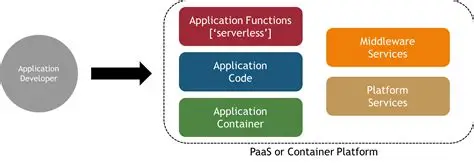
Containers addressed this challenge by packaging:
- Application code
- Dependencies
- Runtime environments
- Configuration requirements
into a portable unit.
The application behaved consistently across environments.
That consistency became incredibly valuable.
Not surprisingly, PaaS providers took notice.
The Original PaaS Tradeoff
Early Platform as a Service environments offered remarkable convenience.
Developers deployed code directly.
The platform handled infrastructure management.
Life became simpler.
There was, however, a tradeoff.
The platform often dictated how applications had to be structured.
Supported runtimes were limited.
Customization options were constrained.
Portability concerns emerged.
Organizations gained simplicity but surrendered flexibility.
Containers fundamentally altered that equation.
Now developers could package applications however they wanted while still benefiting from managed platform services.
The relationship shifted from competition to collaboration.
How Container Support Works in Modern PaaS
Not all platforms implement containers in the same way.
The underlying approaches vary considerably.
Container Deployment Models
| Approach | Description | Examples |
|---|---|---|
| Direct Container Deployment | Upload a container image directly | Google Cloud Run, Fly.io |
| Dockerfile-Based Deployment | Platform builds image from source code | Render, Railway |
| Managed Kubernetes | Containers orchestrated through Kubernetes | OpenShift |
| Hybrid Runtime Support | Traditional runtimes plus containers | Azure App Service |
| Infrastructure-Backed Containers | Containers running on cloud resources | AWS Elastic Beanstalk |
Despite implementation differences, the user experience remains remarkably similar.
Developers define the application.
The platform manages execution.
That principle sits at the heart of modern PaaS.
Why PaaS Providers Embraced Containers
The decision was not accidental.
Containers solve several problems simultaneously.
Portability
Applications become easier to move between environments.
This flexibility appeals to customers.
Organizations become less dependent on platform-specific configurations.
Ironically, greater portability often increases customer confidence.
And confident customers tend to stay longer.
Consistency
Containers reduce deployment variability.
The same image runs in development, testing, and production.
Fewer surprises.
Fewer troubleshooting sessions.
Greater operational reliability.
Broader Language Support
Containers eliminate many runtime limitations.
If an application can run inside a container, the platform can often support it.
This dramatically expands compatibility options.
Simplified Scaling
Containerized workloads integrate naturally with modern orchestration systems.
Scaling becomes more predictable.
Resource management becomes more efficient.
Providers benefit.
Customers benefit.
The incentives align.
Which PaaS Platforms Offer the Best Container Support?
Not all container experiences are equal.
Some platforms were designed around containers from the beginning.
Others adapted later.
That distinction influences developer experience.
Google Cloud Run
Cloud Run is arguably one of the clearest examples of container-first PaaS.
Applications are deployed as container images.
The platform automatically manages:
- Scaling
- Networking
- Availability
- Resource allocation
Developers focus on the container.
Google handles the infrastructure.
The separation of responsibilities feels remarkably clean.
Render
Render has become increasingly popular among startups and modern development teams.
Container deployment is straightforward.
Developers can deploy directly from Dockerfiles or repositories.
The platform preserves simplicity while supporting cloud-native workflows.
This balance has attracted significant attention.
Fly.io
Fly.io approaches deployment through a globally distributed architecture.
Container support sits at the center of the experience.
Applications run close to users.
Deployment remains relatively simple.
The result is an interesting combination of performance and portability.
Azure App Service
Azure supports containerized workloads while continuing to support traditional deployment methods.
This flexibility appeals particularly to organizations managing diverse application portfolios.
Not every application must follow the same deployment model.
OpenShift
OpenShift takes a different approach.
Container support is foundational.
Kubernetes orchestration is deeply integrated.
The platform targets organizations seeking governance, consistency, and enterprise-grade operational controls.
The learning curve is steeper.
The capabilities are extensive.
Containers Don't Eliminate the Value of PaaS
One misconception appears repeatedly in cloud discussions.
Some developers assume containers make PaaS unnecessary.
The logic sounds reasonable.
If containers solve deployment portability, why use PaaS at all?
The answer lies in everything containers do not solve.
Containers package applications.
They do not automatically provide:
- Monitoring
- Scaling
- Logging
- Security management
- Infrastructure operations
- Networking services
Someone must still manage those concerns.
PaaS platforms absorb much of that responsibility.
The combination becomes powerful.
Containers provide portability.
PaaS provides operational simplicity.
Together, they create a compelling model.
A Lesson Learned from a Container Migration
Several years ago, I worked with a software company transitioning from traditional deployments to containerized applications.
The leadership team expected containers to solve nearly every operational challenge.
Consistency improved almost immediately.
Deployments became more predictable.
Environment-related issues declined.
Everyone was pleased.
Then a new realization emerged.
Containerization had simplified packaging.
It had not simplified operations.
The organization still needed monitoring.
Still needed scaling policies.
Still needed deployment automation.
Still needed infrastructure expertise.
Eventually, the team adopted a container-friendly PaaS platform.
That decision transformed the experience.
Containers provided consistency.
The platform provided leverage.
The lesson was surprisingly simple.
Technology layers are most valuable when they complement one another rather than compete.
Do Containers Increase Vendor Flexibility?
This question surfaces frequently.
And for good reason.
Vendor lock-in remains a persistent concern.
Containers can help mitigate that risk.
Because applications are packaged independently of the hosting environment, migration becomes easier.
Not effortless.
But easier.
Organizations gain options.
Future platform decisions become less constrained.
That flexibility creates strategic value.
Even if migration never occurs.
The ability to move often matters almost as much as the act itself.
Container Support and Multi-Language Applications
One of the most fascinating consequences of container adoption is language neutrality.
Historically, PaaS platforms advertised runtime support.
Python.
Java.
Ruby.
PHP.
Node.js.
Containerized environments change the conversation.
The platform supports containers.
The container supports the language.
This distinction expands possibilities dramatically.
Organizations can run:
- Rust services
- Go applications
- Legacy software
- Emerging languages
- Custom runtimes
without waiting for explicit platform support.
Container support becomes a compatibility multiplier.
The Future of PaaS Is Increasingly Container-Centric
The trajectory is difficult to ignore.
Modern PaaS platforms increasingly assume containerized workloads.
Cloud-native development practices reinforce this trend.
Developer expectations reinforce it further.
Yet an interesting paradox exists.
As containers become more important, they often become less visible.
The best platforms hide much of the underlying complexity.
Developers deploy applications.
Containers operate behind the scenes.
The user experience remains simple.
The architecture becomes more sophisticated.
That combination represents the direction many providers are pursuing.
Should Every Application Use Containers?
Not necessarily.
This is where nuance matters.
Many simple applications deploy perfectly well without explicit container management.
A developer pushing a Node.js application to Render may never interact directly with Docker.
And that's perfectly reasonable.
Containers are a means to an end.
Not an end unto themselves.
The objective remains delivering reliable software efficiently.
For some teams, containers enhance that objective.
For others, platform-managed runtimes may provide sufficient simplicity.
The best choice depends on organizational needs.
Conclusion: The Relationship Between PaaS and Containers Has Fundamentally Changed
The question used to be whether organizations should choose Platform as a Service or containers.
Today, that framing feels increasingly outdated.
Modern cloud platforms have largely merged the strengths of both approaches.
Containers provide consistency.
Portability.
Flexibility.
PaaS provides automation.
Operational simplicity.
Managed infrastructure.
Together, they address many of the challenges that previously forced organizations into difficult tradeoffs.
So, does PaaS support containers?
Absolutely.
In many cases, containers have become one of the defining characteristics of modern PaaS environments.
But the more interesting conclusion is this:
The future of software deployment is not about choosing between abstraction and control.
It is about combining them intelligently.
Organizations no longer need to sacrifice flexibility to gain simplicity.
Increasingly, they can have both.
And that shift may be one of the most consequential developments in the evolution of cloud computing.
- Arts
- Business
- Computers
- Juegos
- Health
- Home
- Kids and Teens
- Money
- News
- Personal Development
- Recreation
- Regional
- Reference
- Science
- Shopping
- Society
- Sports
- Бизнес
- Деньги
- Дом
- Досуг
- Здоровье
- Игры
- Искусство
- Источники информации
- Компьютеры
- Личное развитие
- Наука
- Новости и СМИ
- Общество
- Покупки
- Спорт
- Страны и регионы
- World

 English
 Russian
 French
 Portuguese
 Deutsch
 Turkish
 Dutch
Dutch
 Italiano
 Arabic
 Romaian
 Portuguese (Brazil)
 Greek
Greek