
What Is the Difference Between Retail and Wholesale? Understanding the Two Engines of Commerce
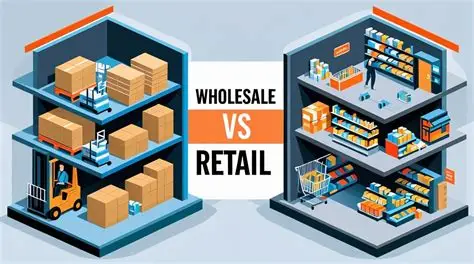
Imagine walking into a neighborhood grocery store and buying a single bottle of olive oil.
Now imagine purchasing 10,000 bottles of that same olive oil to distribute across hundreds of stores nationwide.
The product is identical.
The transaction is not.
One purchase belongs to the world of retail. The other belongs to wholesale.
At first glance, the distinction appears straightforward. Retailers sell products to consumers. Wholesalers sell products to businesses.
Case closed.
Yet that simple explanation overlooks a much richer story. Retail and wholesale are not merely different stages of commerce. They represent fundamentally different business models, economic logics, customer relationships, and strategic priorities.
Understanding the difference matters because these two systems work together to move products from factories to households. Remove either one, and modern commerce becomes significantly less efficient.
The irony is that consumers interact with retail constantly while rarely noticing wholesale at all.
Retail occupies storefronts, websites, mobile apps, and shopping centers.
Wholesale typically operates behind the scenes.
Invisible.
Yet indispensable.
To understand how products reach consumers—and why pricing, inventory, and availability work the way they do—it helps to understand the relationship between these two worlds.
Defining Retail and Wholesale
The distinction begins with the customer.
What Is Retail?
Retail refers to the sale of goods or services directly to end consumers for personal use.
Retailers interact with individual shoppers.
Examples include:
- Grocery stores
- Department stores
- Online marketplaces
- Specialty retailers
- Convenience stores
The retail transaction represents the final stage of the supply chain.
This is where products leave commercial circulation and enter consumers' lives.
What Is Wholesale?
Wholesale refers to the sale of products in large quantities to businesses rather than individual consumers.
Wholesalers typically sell to:
- Retailers
- Distributors
- Commercial buyers
- Institutional purchasers
The wholesale transaction occurs earlier in the supply chain.
Its purpose is distribution rather than direct consumption.
This difference seems simple.
Its implications are substantial.
The Supply Chain Reveals Everything
One of the easiest ways to understand retail and wholesale is by following a product's journey.
Consider a manufacturer producing coffee mugs.
The process often looks like this:
Manufacturer → Wholesaler → Retailer → Consumer
Each participant performs a distinct function.
Manufacturers create products.
Wholesalers distribute products.
Retailers present products to consumers.
Consumers purchase products.
Every stage adds value.
But the value added at each stage differs considerably.
The Core Difference: Who Is the Customer?
This is the defining distinction.
Retailers serve consumers.
Wholesalers serve businesses.
Everything else flows from that reality.
Retailers focus on:
- Customer experience
- Product presentation
- Brand perception
- Convenience
- Service
Wholesalers focus on:
- Distribution efficiency
- Inventory management
- Volume transactions
- Supply reliability
- Business relationships
Different customers create different priorities.
Different priorities create different business models.
Retail and Wholesale Compared
| Category | Retail | Wholesale |
|---|---|---|
| Primary Customer | Individual consumers | Businesses |
| Purchase Volume | Low to moderate | High |
| Average Transaction Size | Smaller | Larger |
| Pricing Structure | Higher per-unit pricing | Lower per-unit pricing |
| Marketing Focus | Consumer engagement | Business relationships |
| Product Presentation | Critical | Less important |
| Customer Service Model | Consumer-oriented | Account-oriented |
| Inventory Movement | Slower per transaction | Faster in bulk |
| Sales Environment | Stores, websites, apps | Distribution centers, B2B platforms |
| Revenue Strategy | Margin optimization | Volume optimization |
The table highlights an important principle.
Retail typically maximizes value per customer interaction.
Wholesale often maximizes efficiency per transaction.
These objectives influence nearly every operational decision.
Why Wholesale Prices Are Lower
Consumers frequently wonder why wholesalers can offer significantly lower prices.
The answer lies in economics.
Volume changes everything.
When a retailer purchases 5,000 units instead of five units, several efficiencies emerge:
- Lower transaction costs
- Reduced marketing expenses
- Simplified fulfillment
- Predictable demand
- Larger order values
Wholesalers pass some of these efficiencies along through lower pricing.
This is not generosity.
It is economics.
Large-volume transactions reduce operational complexity.
Lower complexity often supports lower prices.
Retail Is About Experience
Barbara Kahn has long emphasized that consumers rarely purchase products based solely on rational calculations.
Retail provides daily evidence.
Walk into a premium cosmetics retailer.
The lighting matters.
The packaging matters.
The store design matters.
The product demonstration matters.
Even the scent in the environment may matter.
Retailers understand that purchasing decisions occur within contexts.
Those contexts influence perception.
A retailer's job extends beyond making products available.
Retailers make products desirable.
That distinction separates retail from wholesale.
Wholesalers move inventory.
Retailers shape demand.
Wholesale Is About Efficiency
If retail specializes in persuasion, wholesale specializes in logistics.
The wholesale business revolves around questions such as:
- How quickly can inventory move?
- How efficiently can orders be fulfilled?
- How accurately can demand be forecasted?
- How reliably can supply chains operate?
Consumers rarely see these activities.
Retailers see them constantly.
A wholesaler's success often depends on operational precision rather than consumer engagement.
The customer relationship exists.
It simply looks different.
Instead of appealing to emotions, wholesalers appeal to business outcomes.
A Lesson Learned About Retail and Wholesale
Several years ago, I worked on a project involving a growing specialty food brand.
Initially, management focused almost exclusively on retail expansion.
Store placement.
Packaging.
Promotions.
Customer acquisition.
All important.
Yet sales growth remained inconsistent.
After examining the broader supply chain, a different issue emerged.
Wholesale distribution was fragmented.
Inventory availability varied significantly across regions. Some retailers struggled to maintain stock. Others experienced delayed replenishment.
The retail strategy was sound.
The wholesale infrastructure was not.
That experience reinforced a lesson that has stayed with me ever since.
Consumers often judge brands through retail experiences.
But those experiences frequently depend on wholesale execution.
The two systems are distinct.
They are also deeply interconnected.
Marketing: Different Audiences, Different Approaches
Retail and wholesale marketing share a common objective—driving sales—but they pursue that objective differently.
Retail Marketing
Retail marketing targets consumers.
Common tactics include:
- Advertising campaigns
- Social media engagement
- Loyalty programs
- Promotions
- Visual merchandising
The focus is demand generation.
Wholesale Marketing
Wholesale marketing targets businesses.
Common approaches include:
- Trade shows
- Industry events
- Business development
- Relationship management
- Account-based selling
The focus is relationship development.
Consumers respond to storytelling.
Businesses respond to operational value.
Inventory Management Differences
Both retailers and wholesalers manage inventory.
The scale and objectives differ.
Retail Inventory
Retailers seek to maintain product availability while minimizing excess stock.
Their challenge involves balancing consumer demand with shelf space limitations.
Wholesale Inventory
Wholesalers often manage significantly larger inventory volumes.
Their challenge involves coordinating supply across multiple customers and geographic markets.
Inventory management affects profitability in both models.
The consequences simply appear in different places.
Technology Is Blurring Traditional Boundaries
Historically, the distinction between retail and wholesale was obvious.
Today, the lines are becoming less rigid.
Several trends contribute to this shift.
Direct-to-Consumer Brands
Manufacturers increasingly sell directly to consumers.
This approach bypasses traditional retail intermediaries.
Digital Wholesale Platforms
Technology has simplified business-to-business purchasing.
Wholesale transactions increasingly occur through online marketplaces.
Hybrid Models
Many organizations now operate across multiple channels simultaneously.
A company may:
- Sell wholesale to retailers
- Operate branded stores
- Run an e-commerce site
- Offer subscription services
The modern marketplace encourages flexibility.
The traditional boundaries still exist.
They are simply more permeable.
Which Business Model Is More Profitable?
This question appears frequently.
The answer is nuanced.
Retail often generates higher margins per unit.
Wholesale often generates higher sales volume.
Consider the tradeoff.
A retailer may earn more profit on a single item.
A wholesaler may sell thousands of items in a single transaction.
Neither model is inherently superior.
Success depends on execution.
Retail rewards customer engagement and brand strength.
Wholesale rewards efficiency and scale.
Different strengths create different opportunities.
Why Both Retail and Wholesale Continue to Matter
Occasionally, predictions emerge suggesting one model will replace the other.
History suggests otherwise.
Retail and wholesale persist because they solve different problems.
Retail addresses consumer needs.
Wholesale addresses distribution needs.
Modern commerce remains remarkably complex.
Manufacturers need efficient channels.
Retailers need reliable supply.
Consumers need convenient access.
Wholesale and retail collectively enable this ecosystem.
The relationship is complementary rather than competitive.
Conclusion: Retail and Wholesale Are Different Ways of Creating Value
So, what is the difference between retail and wholesale?
The conventional answer is simple.
Retail sells to consumers.
Wholesale sells to businesses.
The deeper answer reveals something more interesting.
Retail and wholesale represent two distinct philosophies of value creation.
Retail creates value through convenience, experience, merchandising, and consumer engagement.
Wholesale creates value through efficiency, scale, logistics, and distribution expertise.
One specializes in influencing demand.
The other specializes in fulfilling it.
One operates in full view of consumers.
The other often operates behind the curtain.
Yet neither functions effectively without the other.
Perhaps that is the most revealing insight.
Consumers often see retail as the face of commerce.
But every retail shelf, every online storefront, every product display depends on an extensive wholesale network quietly performing its role.
Retail may capture attention.
Wholesale keeps products moving.
And together, they form one of the most important partnerships in modern business.
- Arts
- Business
- Computers
- Jeux
- Health
- Domicile
- Kids and Teens
- Argent
- News
- Personal Development
- Recreation
- Regional
- Reference
- Science
- Shopping
- Society
- Sports
- Бизнес
- Деньги
- Дом
- Досуг
- Здоровье
- Игры
- Искусство
- Источники информации
- Компьютеры
- Личное развитие
- Наука
- Новости и СМИ
- Общество
- Покупки
- Спорт
- Страны и регионы
- World

 English
 Russian
 Spanish
 Portuguese
 Deutsch
 Turkish
 Dutch
Dutch
 Italiano
 Arabic
 Romaian
 Portuguese (Brazil)
 Greek
Greek
