
How Does RFID Work in Retail? The Technology That Sees What Barcodes Cannot
A sweater disappears.
Not literally. It doesn't evaporate from the sales floor or slip into some retail wormhole. Yet, according to the inventory system, it exists. According to the associate searching the stockroom, it does not.
Now multiply that discrepancy by hundreds of products, across dozens of stores, over thousands of transactions.
Retailers have spent decades wrestling with this problem. Products are constantly moving—onto shelves, into fitting rooms, through checkout lanes, between stores, back from returns, and sometimes into places nobody can quite explain. The result is inventory distortion, a deceptively simple phrase that masks an expensive reality.
Customers see a product online and drive to a store only to discover it isn't there. Store associates spend valuable time hunting for merchandise. Executives make replenishment decisions using imperfect data.
The irony is hard to miss. Retailers know more about consumer behavior than ever before, yet many still struggle to answer a remarkably basic question:
Where is the product?
This is where RFID enters the conversation.
Radio Frequency Identification, better known as RFID, has become one of the most influential technologies in modern retail. Not because it changes how customers shop directly. Most never notice it. Rather, it changes how retailers see.
And in retail, visibility is often the difference between efficiency and chaos.
What Is RFID?
RFID stands for Radio Frequency Identification.
It is a technology that uses radio waves to identify, track, and manage physical items without requiring direct line-of-sight scanning.
That last phrase matters.
Barcodes require visibility. Someone must physically position a scanner toward a printed code.
RFID works differently.
An RFID reader communicates wirelessly with RFID tags attached to products. Information is transmitted through radio frequencies, allowing multiple items to be identified simultaneously.
A retailer can scan hundreds of products in seconds.
No individual scanning.
No manual counting.
No direct visual contact.
The implications are substantial.
The Three Core Components of RFID
At first glance, RFID appears highly technical. In practice, its architecture is surprisingly straightforward.
Every RFID system consists of three primary elements.
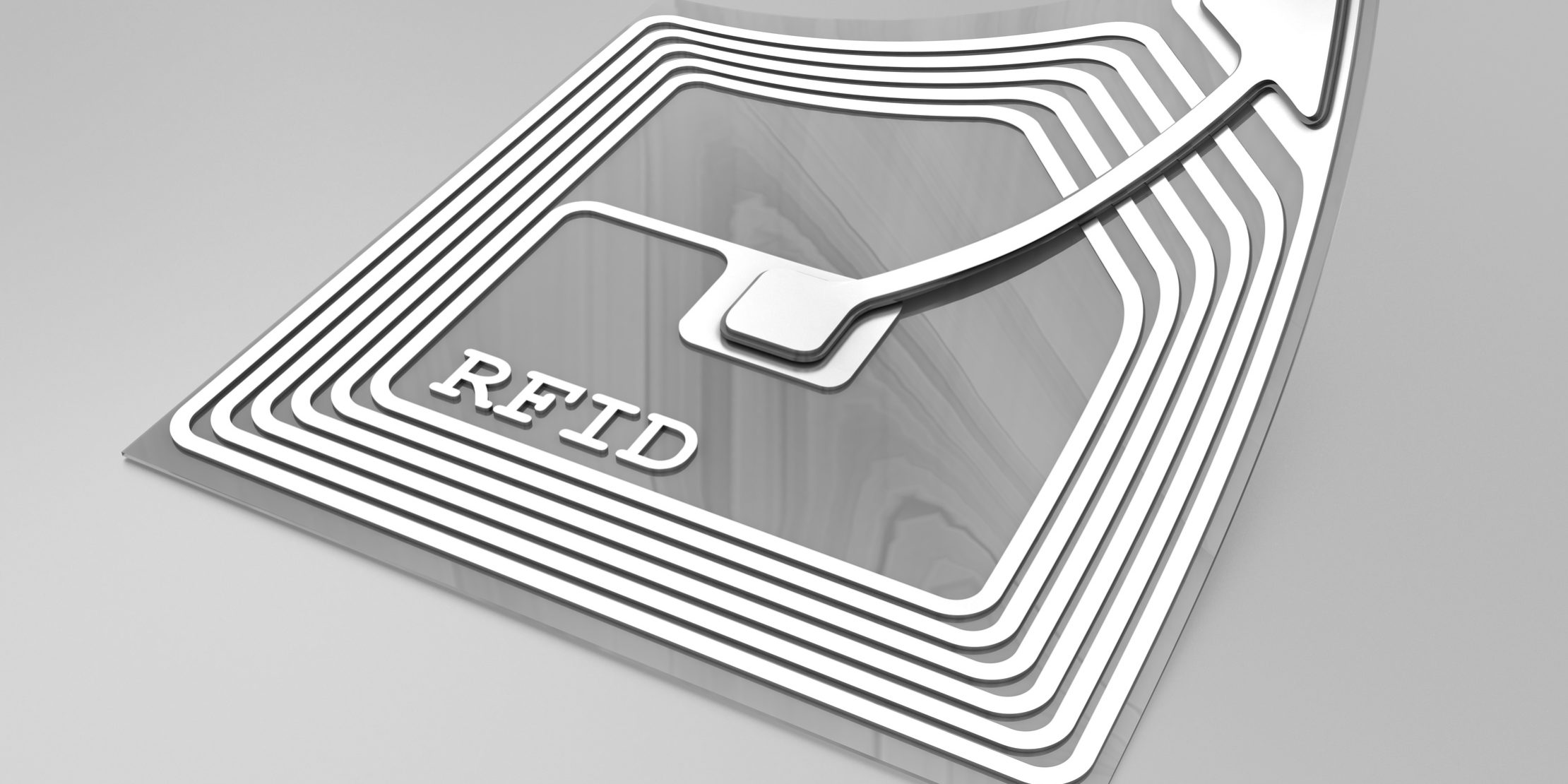
RFID Tags
The tag is attached to a product.
Inside that small label are:
- A microchip
- An antenna
- A unique identification number
Each tag essentially acts as a digital identity card.
Unlike traditional barcodes, which often identify product categories, RFID tags can identify individual items.
Not just a blue sweater.
That specific blue sweater.
RFID Readers
Readers send radio signals and receive responses from RFID tags.
These devices may be:
- Handheld scanners
- Fixed readers at store entrances
- Distribution center portals
- Shelf-mounted readers
The reader captures information automatically whenever tagged products enter its detection range.
RFID Software
Data without interpretation has limited value.
RFID software converts raw reads into actionable information.
Retailers use software platforms to:
- Monitor inventory
- Track product movement
- Analyze stock levels
- Improve replenishment planning
- Detect anomalies
The software transforms visibility into decision-making.
How RFID Actually Works in Retail
The process begins long before a product reaches a store.
A manufacturer attaches an RFID tag to an item during production.
That tag contains a unique electronic identifier.
As the item moves through the supply chain, RFID readers capture information automatically.
Warehouse arrival.
Distribution center transfer.
Store delivery.
Sales floor placement.
Checkout.
Return.
Each movement leaves a digital footprint.
The product effectively narrates its own journey.
What makes RFID remarkable is its ability to gather information continuously rather than episodically.
Barcodes create snapshots.
RFID creates a movie.
RFID vs. Barcode Technology
Many retailers initially assume RFID simply represents a faster barcode.
That interpretation understates the difference.
The technologies solve fundamentally different problems.
| Feature | Barcode | RFID |
|---|---|---|
| Requires Line of Sight | Yes | No |
| Scan Speed | One item at a time | Hundreds simultaneously |
| Read Range | Inches | Several feet or more |
| Data Capacity | Limited | Greater storage capability |
| Durability | Moderate | High |
| Inventory Accuracy | Lower | Higher |
| Automation Potential | Limited | Extensive |
| Individual Item Tracking | Basic | Advanced |
| Labor Requirements | Higher | Lower |
| Real-Time Visibility | Minimal | Significant |
The distinction becomes especially important as retailers attempt to manage increasingly complex omnichannel operations.
Customers expect inventory information to be accurate.
RFID makes that expectation more realistic.
Why Retailers Adopt RFID
The immediate answer is inventory accuracy.
The deeper answer is confidence.
Retail decisions become more effective when inventory data becomes more reliable.
Without accurate inventory information, nearly every retail function suffers.
Forecasting weakens.
Replenishment slows.
Customer satisfaction declines.
Operational costs increase.
RFID addresses these challenges by improving visibility across the organization.
Inventory Accuracy Improves Dramatically
Traditional inventory accuracy often falls between 60% and 80%.
That statistic surprises many people.
Retail systems frequently believe products exist when they do not—or vice versa.
RFID implementations often push inventory accuracy above 95%.
That improvement may sound incremental.
It isn't.
Moving from uncertainty to confidence changes how businesses operate.
Faster Inventory Counts
Physical inventory counting has traditionally been labor-intensive.
Associates scan products individually.
Counts take hours.
Sometimes days.
RFID compresses that process dramatically.
A store employee can walk through a sales floor with a handheld reader and capture inventory information within minutes.
Labor shifts from counting products to serving customers.
An important distinction.
The Fitting Room Revelation
One of the most fascinating RFID applications appears in fitting rooms.
Retailers discovered something surprising.
Products entering fitting rooms often reveal stronger purchase intent than products merely handled on the sales floor.
RFID-enabled fitting rooms can identify which items customers bring inside.
Retailers gain visibility into:
- Products frequently tried on
- Products frequently purchased
- Products frequently abandoned
Those insights create opportunities.
Perhaps sizing needs adjustment.
Perhaps product placement requires improvement.
Perhaps pricing creates friction.
The fitting room becomes a source of intelligence.
Not just a place to change clothes.
RFID and Omnichannel Retail
The modern shopper moves fluidly between channels.
Retailers must do the same.
Buy online.
Pick up in store.
Ship from store.
Return anywhere.
Reserve online.
Purchase later.
These experiences depend on accurate inventory visibility.
I remember visiting a retailer several years ago during an omnichannel transformation initiative. Leadership believed the biggest challenge involved website optimization.
Then inventory audits began.
Store-level accuracy was inconsistent. Products shown as available online were often missing in physical locations.
The website wasn't the issue.
The inventory data was.
That experience reinforced a lesson I continue to encounter: customer experience problems often originate in operational systems.
RFID helped solve the visibility challenge because employees finally knew what inventory actually existed.
Not what the system assumed existed.
What truly existed.
Loss Prevention and Shrink Reduction
Retail shrink remains one of the industry's persistent challenges.
Products disappear through:
- Theft
- Administrative errors
- Misplaced inventory
- Process failures
RFID creates greater accountability.
When merchandise movement becomes visible, anomalies become easier to identify.
Retailers can detect:
- Missing items
- Unexpected inventory movements
- Unauthorized product transfers
The technology doesn't eliminate shrink entirely.
But it reduces uncertainty.
And uncertainty often carries significant costs.
The Economics of RFID
For years, RFID adoption faced a simple obstacle.
Cost.
Tags were expensive.
Infrastructure required investment.
Returns were uncertain.
Those economics have changed.
RFID tag costs have declined substantially.
Cloud-based software has improved accessibility.
Implementation methodologies have matured.
As a result, retailers increasingly evaluate RFID not as an experimental technology but as an operational necessity.
Particularly in categories such as:
- Apparel
- Footwear
- Luxury goods
- Sporting goods
- Department stores
The business case has become easier to justify.
Challenges Retailers Still Face
RFID is powerful.
It is not magical.
Implementation requires planning.
Initial Investment
Readers, software, infrastructure, and tagging programs create upfront expenses.
The financial commitment can be significant.
Process Redesign
Technology adoption often exposes outdated workflows.
Retailers may need to redesign operational processes.
This requires organizational discipline.
Employee Training
Systems create value only when people use them effectively.
Training remains essential.
Data Management
More visibility generates more data.
Retailers must convert information into action.
Otherwise, visibility alone provides limited benefit.
The Future of RFID in Retail
The most interesting aspect of RFID may not be where it is today.
It may be where it is heading.
As artificial intelligence becomes more integrated into retail operations, RFID data gains additional value.
Real-time inventory information can support:
- Automated replenishment
- Predictive forecasting
- Dynamic merchandising
- Enhanced customer personalization
Meanwhile, RFID hardware continues to become smaller, cheaper, and more sophisticated.
The technology is gradually fading into the background.
Which is often the hallmark of successful innovation.
Customers don't need to notice it.
Retailers do.
Conclusion: RFID Is Not About Tracking Products. It's About Reducing Guesswork.
At first glance, RFID appears to be an inventory technology.
And technically, it is.
But that description feels incomplete.
The deeper value lies elsewhere.
Retail organizations make thousands of decisions every day. Which products to reorder. Which stores need replenishment. Which customers to target. Which promotions to launch.
Every one of those decisions depends on information.
The quality of the decision rarely exceeds the quality of the information supporting it.
RFID improves that information.
It reduces blind spots.
It narrows uncertainty.
It transforms inventory from an estimate into a measurable reality.
And perhaps that is the most provocative implication of all.
Retailers have spent decades searching for better forecasting models, smarter marketing strategies, and more sophisticated analytics tools.
Yet many competitive advantages begin with something far simpler.
Knowing where the product actually is.
RFID does not merely help retailers count merchandise.
It helps them see their business more clearly.
And clarity, more often than not, becomes a competitive advantage.
- Arts
- Business
- Computers
- الألعاب
- Health
- الرئيسية
- Kids and Teens
- مال
- News
- Personal Development
- Recreation
- Regional
- Reference
- Science
- Shopping
- Society
- Sports
- Бизнес
- Деньги
- Дом
- Досуг
- Здоровье
- Игры
- Искусство
- Источники информации
- Компьютеры
- Личное развитие
- Наука
- Новости и СМИ
- Общество
- Покупки
- Спорт
- Страны и регионы
- World

 English
 Russian
 French
 Spanish
 Portuguese
 Deutsch
 Turkish
 Dutch
Dutch
 Italiano
 Romaian
 Portuguese (Brazil)
 Greek
Greek
