
What Is the Shared Responsibility Model?
The first time I heard the phrase shared responsibility model, I thought it sounded suspiciously like corporate diplomacy. The kind of phrase designed to make everyone feel included and no one feel accountable.
Then I watched a company suffer a major cloud security incident.
The leadership team insisted the cloud provider should have prevented it. The cloud provider pointed to its documentation. The security team blamed configuration errors. The operations team cited staffing shortages. Everyone had a plausible explanation. Nobody had a complete answer.
That experience taught me something that marketing professors often emphasize when discussing brands and customer trust: confusion thrives wherever expectations are poorly defined. Consumers abandon brands when promises are ambiguous. Organizations expose themselves to risk for exactly the same reason.
The shared responsibility model exists to eliminate that ambiguity.
At its core, it is a framework that defines who is responsible for what in a technology environment—particularly in cloud computing. It clarifies where the provider's duties end and where the customer's obligations begin. Without that distinction, organizations frequently assume protection that was never promised.
The model is simple in theory. In practice, it remains one of the most misunderstood concepts in modern technology.
Understanding the Shared Responsibility Model
The shared responsibility model is a security and operational framework that divides responsibilities between a cloud service provider (CSP) and the customer using the service.
Think of it less as a contract and more as a boundary map.
The cloud provider secures the infrastructure that powers the service. The customer secures how that service is configured, accessed, and used.
That distinction matters because cloud providers and customers operate at different layers of the technology stack.
A provider may secure physical servers, networking equipment, and data centers. The customer, meanwhile, controls user permissions, data classification, application settings, and access policies.
The result is shared accountability—but not equal accountability.
Each party owns different risks.
The Basic Principle
Cloud providers are generally responsible for security of the cloud.
Customers are generally responsible for security in the cloud.
The difference between those two prepositions—of and in—may be the most important distinction in cloud security.
Why the Shared Responsibility Model Exists
Before cloud computing became widespread, organizations owned nearly everything.
They purchased servers. They maintained facilities. They managed operating systems. They patched software. They secured networks.
Responsibility was centralized.
Cloud computing changed that equation. Infrastructure became a service. Storage became a service. Entire applications became services.
As vendors assumed more operational duties, responsibility naturally shifted. But it never disappeared.
This is where many organizations make a costly assumption. They believe outsourcing infrastructure means outsourcing risk.
It does not.
Risk changes shape. It migrates. It becomes distributed.
The shared responsibility model was created to define those new boundaries.
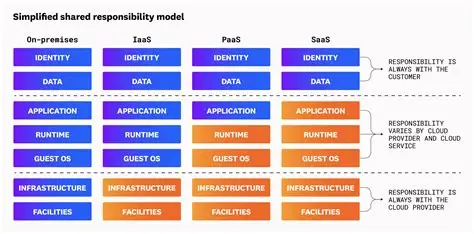
How Responsibility Changes Across Cloud Service Models
One of the most important nuances is that responsibility shifts depending on the cloud service being used.
The more management a provider offers, the less operational burden remains with the customer.
Infrastructure as a Service (IaaS)
With Infrastructure as a Service, customers retain significant control.
Examples include virtual machines, storage resources, and networking components.
The provider manages:
- Physical facilities
- Hardware
- Networking infrastructure
- Hypervisors
The customer manages:
- Operating systems
- Applications
- Data
- Identity and access management
- Security configurations
Platform as a Service (PaaS)
Platform as a Service reduces customer responsibilities.
The provider manages:
- Infrastructure
- Operating systems
- Runtime environments
- Middleware
The customer manages:
- Applications
- Data
- User access
- Business logic
Software as a Service (SaaS)
Software as a Service transfers even more operational responsibility to the vendor.
The provider manages:
- Infrastructure
- Platform
- Applications
- Maintenance
- Updates
The customer still manages:
- Data governance
- User permissions
- Account security
- Compliance requirements
Interestingly, many SaaS customers underestimate how much responsibility remains on their side. A poorly configured permissions structure can create significant exposure regardless of how secure the application itself may be.
Shared Responsibility Across Cloud Models
| Responsibility Area | Traditional On-Premises | IaaS | PaaS | SaaS |
|---|---|---|---|---|
| Physical Data Center | Customer | Provider | Provider | Provider |
| Networking Hardware | Customer | Provider | Provider | Provider |
| Servers & Storage | Customer | Provider | Provider | Provider |
| Operating Systems | Customer | Customer | Provider | Provider |
| Middleware | Customer | Customer | Provider | Provider |
| Runtime Environment | Customer | Customer | Provider | Provider |
| Applications | Customer | Customer | Customer | Provider |
| Identity & Access Management | Customer | Customer | Customer | Customer |
| Data Protection | Customer | Customer | Customer | Customer |
| Compliance Controls | Customer | Customer | Customer | Customer |
The table reveals a subtle but important reality: as cloud services become more managed, operational responsibilities shrink, but governance responsibilities remain stubbornly attached to the customer.
That attachment rarely disappears.
The Most Common Misconceptions
The shared responsibility model is not difficult to understand. Yet organizations routinely misinterpret it.
Why?
Because people tend to equate payment with ownership.
If a company pays for a cloud service, executives often assume security is included in the same way electricity is included when leasing office space.
That assumption creates three recurring misconceptions.
Misconception #1: The Cloud Provider Protects Everything
Cloud providers invest billions of dollars in security.
Yet even the most sophisticated provider cannot determine who inside an organization should access sensitive files.
They cannot classify proprietary information.
They cannot decide whether an employee should have administrative privileges.
Those decisions belong to the customer.
Misconception #2: Compliance Is Fully Outsourced
Many providers maintain certifications and compliance attestations.
That helps.
It does not eliminate customer obligations.
A healthcare organization remains responsible for protecting patient data. A financial institution remains accountable for safeguarding customer information.
Regulators generally care about outcomes, not excuses.
Misconception #3: Security Tools Equal Security
Organizations sometimes purchase advanced cloud security tools and assume risk has been addressed.
Technology helps.
Governance matters more.
An unused security control provides roughly the same protection as a locked door left open.
The Human Side of Shared Responsibility
Technology discussions often focus on infrastructure diagrams and security controls.
The more interesting challenge is organizational behavior.
Responsibility becomes blurry when teams operate in silos.
The security team assumes IT owns a configuration. IT assumes application owners are responsible. Application owners assume the cloud provider has already secured it.
The result is not negligence.
It is diffusion.
Behavioral researchers have documented this phenomenon for decades. When responsibility is distributed among multiple parties, individuals frequently assume someone else has taken action.
Cloud environments can amplify that tendency.
The shared responsibility model exists partly to counteract it.
By defining ownership explicitly, organizations reduce uncertainty and improve accountability.
A Lesson Learned the Hard Way
Several years ago, I participated in a review of a cloud migration initiative.
The technical architecture was impressive. The migration timeline was aggressive. The executive presentations were polished.
What was missing was a simple responsibility matrix.
Nobody had clearly documented who owned encryption settings, access reviews, logging policies, or backup validation.
Those omissions seemed minor during planning.
They became major concerns during implementation.
Weeks were spent resolving questions that should have been answered on day one. Not because the team lacked expertise, but because responsibility had never been assigned with precision.
The lesson was surprisingly straightforward: technology scales faster than accountability.
Whenever organizations move workloads to the cloud, responsibility mapping should happen before deployment, not after.
That insight has stayed with me because it applies far beyond cybersecurity. Whether managing a brand portfolio, a customer experience strategy, or a cloud environment, success often depends less on capability than on clarity.
Best Practices for Managing Shared Responsibility
Organizations that succeed with cloud security typically adopt several common practices.
Create a Responsibility Matrix
Document every major control area.
Identify owners.
Remove ambiguity.
If two groups believe they own a task, coordination is required. If no group believes it owns a task, risk is already accumulating.
Strengthen Identity Management
User access remains one of the most critical customer responsibilities.
Organizations should implement:
- Multi-factor authentication
- Least-privilege access
- Regular permission reviews
- Centralized identity governance
Monitor Continuously
Cloud environments change constantly.
New applications appear. Permissions evolve. Configurations drift.
Periodic reviews are insufficient.
Continuous monitoring helps organizations identify vulnerabilities before they become incidents.
Train Employees
Many security failures begin with human decisions rather than technical flaws.
Training should extend beyond security teams.
Business users, administrators, executives, and developers all influence risk outcomes.
Understand Provider Documentation
Every major cloud provider publishes detailed guidance outlining shared responsibilities.
Organizations should review these materials carefully rather than relying on assumptions.
Assumptions rarely survive contact with reality.
Why the Shared Responsibility Model Matters More Than Ever
Cloud adoption continues to accelerate.
Organizations now operate across multiple cloud providers, hybrid environments, SaaS ecosystems, and distributed workforces.
Complexity has become the default condition.
The shared responsibility model provides structure within that complexity.
More importantly, it establishes a principle that extends beyond technology: responsibility cannot be outsourced entirely.
Infrastructure can be outsourced.
Applications can be outsourced.
Operations can be outsourced.
Accountability cannot.
That distinction explains why the model remains relevant regardless of technological evolution.
Artificial intelligence, edge computing, and next-generation cloud services may alter technical architectures. They will not eliminate the need to define ownership.
Someone will always be responsible.
The only question is whether everyone understands who that person is.
Conclusion: The Most Dangerous Security Risk Is Assumption
The shared responsibility model is often described as a cloud security framework. That definition is accurate, but incomplete.
It is also a framework for expectation management.
Every major failure contains an assumption somewhere in its origin story. Someone assumed a control existed. Someone assumed a process was monitored. Someone assumed another team was responsible.
Those assumptions create the gaps where risk flourishes.
The shared responsibility model forces organizations to confront those gaps directly. It replaces vague expectations with explicit ownership. It transforms responsibility from a collective abstraction into a concrete obligation.
And perhaps that is its most valuable contribution.
Not stronger technology. Not better infrastructure.
Greater clarity.
Because when responsibility is shared but not understood, accountability disappears. When responsibility is shared and understood, trust becomes possible—and trust, whether in a cloud platform or a global brand, remains one of the most valuable assets any organization can possess.
- Arts
- Business
- Computers
- Jogos
- Health
- Início
- Kids and Teens
- Money
- News
- Personal Development
- Recreation
- Regional
- Reference
- Science
- Shopping
- Society
- Sports
- Бизнес
- Деньги
- Дом
- Досуг
- Здоровье
- Игры
- Искусство
- Источники информации
- Компьютеры
- Личное развитие
- Наука
- Новости и СМИ
- Общество
- Покупки
- Спорт
- Страны и регионы
- World

 English
 Russian
 French
 Spanish
 Deutsch
 Turkish
 Dutch
Dutch
 Italiano
 Arabic
 Romaian
 Portuguese (Brazil)
 Greek
Greek
