
What is the difference between comparative and absolute advantage?
What Is the Difference Between Comparative and Absolute Advantage?
Comparative advantage and absolute advantage are two important concepts in economics that help explain why countries, businesses, and individuals specialize in producing certain goods and services and engage in trade. Although the concepts are closely related, they describe different types of economic efficiency. Understanding the difference between them is essential for understanding international trade and why trade can benefit countries even when one country is more productive in every area.
What Is Absolute Advantage?
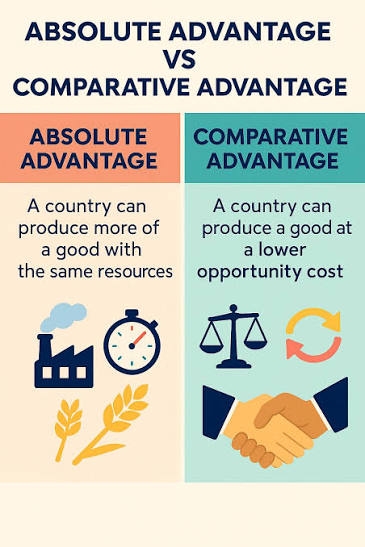
Absolute advantage refers to the ability of a person, business, or country to produce a greater quantity of a good or service using the same amount of resources, or to produce the same quantity using fewer resources.
The concept was introduced by economist Adam Smith in his influential work The Wealth of Nations, published in 1776. Smith argued that countries should specialize in producing goods for which they have an absolute advantage and trade with other countries for goods they produce less efficiently.
For example, imagine two countries, Country A and Country B. With the same amount of labor and resources, their production is:
| Country | Wheat | Clothing |
|---|---|---|
| Country A | 100 tons | 50 units |
| Country B | 60 tons | 80 units |
Country A can produce more wheat than Country B, so it has an absolute advantage in wheat. Country B can produce more clothing, so it has an absolute advantage in clothing.
In this situation, specialization and trade can allow both countries to benefit. Country A can focus more on wheat, while Country B focuses more on clothing, and they can exchange their products.
What Is Comparative Advantage?
Comparative advantage is different. It refers to the ability to produce a good or service at a lower opportunity cost than another producer.
Opportunity cost is what must be given up to produce something else. Comparative advantage therefore focuses not simply on who can produce more, but on what each producer gives up to produce an additional unit of a particular good.
The concept of comparative advantage was developed by economist David Ricardo in the early nineteenth century. Ricardo demonstrated that trade can benefit both countries even when one country has an absolute advantage in producing every good.
Consider another example:
| Country | Wheat | Clothing |
|---|---|---|
| Country A | 100 | 50 |
| Country B | 80 | 40 |
Country A has an absolute advantage in both wheat and clothing because it can produce more of both goods.
At first, it might seem that Country A has no reason to trade with Country B. However, absolute productivity is not the only factor that matters.
To understand comparative advantage, we calculate opportunity costs.
For Country A, producing 1 unit of clothing requires giving up 2 units of wheat:
100 wheat ÷ 50 clothing = 2 wheat per clothing
For Country B, producing 1 unit of clothing requires giving up 2 units of wheat as well:
80 wheat ÷ 40 clothing = 2 wheat per clothing
In this particular example, neither country has a comparative advantage because their opportunity costs are identical. Let's modify the figures:
| Country | Wheat | Clothing |
|---|---|---|
| Country A | 100 | 50 |
| Country B | 80 | 20 |
Country A still has an absolute advantage in both goods.
For Country A:
-
1 unit of clothing costs 2 units of wheat.
-
1 unit of wheat costs 0.5 units of clothing.
For Country B:
-
1 unit of clothing costs 4 units of wheat.
-
1 unit of wheat costs 0.25 units of clothing.
Therefore, Country A has a comparative advantage in clothing, because it gives up only 2 units of wheat to produce one unit of clothing, compared with 4 units for Country B.
Country B has a comparative advantage in wheat, because it gives up only 0.25 units of clothing to produce one unit of wheat, compared with 0.5 units for Country A.
This means that Country A should specialize relatively more in clothing, while Country B should specialize relatively more in wheat, even though Country A is absolutely more productive in both.
Key Difference Between Absolute and Comparative Advantage
The main difference is the measure used to determine efficiency.
Absolute advantage is based on productivity. It asks:
Who can produce more with the same resources?
Comparative advantage is based on opportunity cost. It asks:
Who gives up less to produce this good?
This distinction is important because a country does not need to be the most productive producer of a good to have a comparative advantage in it.
| Feature | Absolute Advantage | Comparative Advantage |
|---|---|---|
| Main idea | Greater productivity | Lower opportunity cost |
| Based on | Production efficiency | Relative costs |
| Key question | Who can produce more? | Who gives up less? |
| Associated economist | Adam Smith | David Ricardo |
| Role in trade | Encourages specialization | Explains gains from specialization and trade |
| Can one country have an advantage in everything? | Yes | No, if opportunity costs differ |
Can a Country Have Both Advantages?
Yes. A country can have an absolute advantage in producing multiple goods and still have a comparative advantage in only some of them.
This is one of the most important distinctions between the two concepts.
Suppose Country A can produce more cars and more computers than Country B. Country A therefore has an absolute advantage in both products. However, if producing an additional car requires Country A to give up a large amount of computer production, while Country B sacrifices relatively little computer production when producing cars, Country B may have the comparative advantage in cars.
Thus, absolute advantage does not automatically determine which country should specialize in a product.
Why Comparative Advantage Matters More for Trade
Comparative advantage is especially important because it explains why mutually beneficial trade can occur even when one country is better at producing everything.
Without comparative advantage, a highly productive country might believe that it has no reason to trade with a less productive country. However, specialization according to comparative advantage can increase total production.
When each country specializes in goods for which it has the lowest opportunity cost, resources can be allocated more efficiently. The countries can then trade and potentially consume more than they could if each tried to produce everything independently.
This principle also applies beyond international trade. Businesses may specialize in activities where they have lower opportunity costs, and individuals can specialize in tasks where their time and skills are used most efficiently.
An Everyday Example
Imagine that a lawyer is also an excellent typist. The lawyer can prepare legal documents faster than an assistant and can also type faster than the assistant.
The lawyer has an absolute advantage in both activities.
However, the lawyer's time spent typing has a significant opportunity cost because that time could have been spent working with clients and providing legal services. The assistant may have a comparative advantage in typing because giving up typing work requires sacrificing less valuable alternatives.
Therefore, even though the lawyer can type faster, it may be economically efficient for the lawyer to specialize in legal work and hire the assistant to handle typing.
This example shows why comparative advantage is not simply about who is better at something. It is about how resources can be used most efficiently.
Limitations of the Concepts
The theories of absolute and comparative advantage are useful models, but real-world trade is more complicated.
Transportation costs, tariffs, government regulations, exchange rates, technological differences, labor conditions, environmental considerations, and economies of scale can all influence trade decisions. Countries may also protect certain industries for strategic or political reasons.
Furthermore, workers and industries affected by international competition may experience job losses or declining wages, even if trade increases overall economic efficiency. As a result, the benefits of trade may not be distributed equally across society.
Nevertheless, comparative and absolute advantage remain valuable tools for understanding the basic economic logic behind specialization and trade.
Conclusion
The difference between comparative and absolute advantage comes down to productivity versus opportunity cost.
Absolute advantage means that a producer can make more of a good or service using the same resources. Comparative advantage means that a producer can make a good or service at a lower opportunity cost than another producer.
A country can have an absolute advantage in every product, but it cannot generally have a comparative advantage in every product when opportunity costs differ. This is why comparative advantage provides a stronger explanation of the potential benefits of international specialization and trade.
In simple terms, absolute advantage asks who is more productive, while comparative advantage asks who sacrifices less to produce something. Understanding this distinction helps explain why countries and individuals specialize, exchange goods and services, and participate in international trade even when their levels of productivity are very different.
- Arts
- Business
- Computers
- Spiele
- Health
- Startseite
- Kids and Teens
- Geld
- News
- Personal Development
- Recreation
- Regional
- Reference
- Science
- Shopping
- Society
- Sports
- Бизнес
- Деньги
- Дом
- Досуг
- Здоровье
- Игры
- Искусство
- Источники информации
- Компьютеры
- Личное развитие
- Наука
- Новости и СМИ
- Общество
- Покупки
- Спорт
- Страны и регионы
- World

 English
 Russian
 French
 Spanish
 Portuguese
 Turkish
 Dutch
Dutch
 Italiano
 Arabic
 Romaian
 Portuguese (Brazil)
 Greek
Greek