
What Technology Stack Is Best for SaaS?
There is a particular kind of mistake that smart SaaS founders make.
They choose their technology stack too early.
The discussion begins innocently enough. React or Vue? Node or Python? PostgreSQL or MongoDB? AWS or something simpler? Monolith or microservices?
Then the conversation becomes tribal.
Engineers have preferences. Investors have opinions. Developers on social media have architectures they swear by. A framework that was obscure six months ago suddenly appears everywhere.
And somewhere underneath all of this noise is the question that actually matters:
What technology stack gives this particular SaaS business the best chance of becoming reliable, scalable, secure, and profitable?
That is a different question.
There is no universally “best” SaaS stack. There is only a stack that fits the product, the team, the customers, the budget, and the expected rate of change.
If I were building a SaaS product today, I would optimize for something unfashionable: the ability to change my mind cheaply.
That principle has saved more engineering teams than architectural cleverness ever will.
What Does “Technology Stack” Actually Mean?
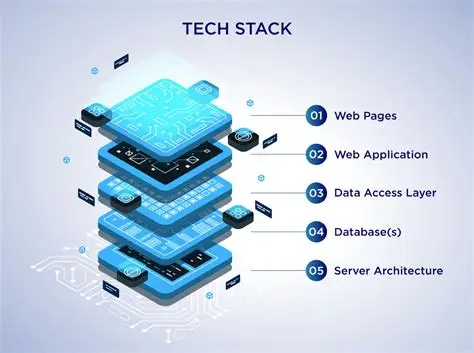
A SaaS stack is the collection of technologies used to build, operate, and improve the application.
It usually includes several layers:
- Frontend: What customers see and interact with
- Backend: Business logic and APIs
- Database: Persistent application data
- Infrastructure: Compute, networking, storage, and deployment
- Authentication: Identity and access management
- Payments: Subscription and billing infrastructure
- Monitoring: Errors, performance, logs, and uptime
- Analytics: Product and business behavior
- Third-party services: Email, search, messaging, file storage, AI, and integrations
The mistake is evaluating each layer independently.
A technology choice creates consequences elsewhere.
A frontend framework affects hiring and development speed. Database architecture affects reporting and scaling. Authentication affects security. Infrastructure affects deployment. Billing affects revenue operations.
The stack is an ecosystem.
Not a shopping list.
The Best Default Stack for Many SaaS Startups
For a typical web-based B2B SaaS product, I would start with a relatively conventional architecture:
Frontend: TypeScript + React/Next.js
Backend: TypeScript/Node.js, Python, or another language the team knows exceptionally well
Database: PostgreSQL
Cache/queues: Redis or a managed equivalent when genuinely needed
File storage: S3-compatible object storage
Authentication: Managed authentication or a mature identity provider
Payments: Stripe or a comparable payment platform
Hosting: A managed cloud platform initially, with deeper cloud infrastructure as requirements justify it
Monitoring: Error tracking, centralized logs, metrics, and uptime monitoring
CI/CD: GitHub Actions or an equivalent automated deployment pipeline
That architecture is not revolutionary.
That's precisely why I like it.
It has mature tooling. Developers are plentiful. Documentation is abundant. Integrations are everywhere. Most importantly, you can build a considerable business without immediately introducing exotic infrastructure.
Why PostgreSQL Is Such a Strong SaaS Default
If I had to make one deliberately boring recommendation, it would be this:
Start with PostgreSQL unless you have a compelling reason not to.
SaaS applications tend to accumulate relationships.
Users belong to organizations.
Organizations have subscriptions.
Subscriptions have invoices.
Projects belong to organizations.
Projects contain tasks.
Tasks have users.
Users have permissions.
Eventually there are audit records, billing events, notifications, integrations, and reporting requirements.
Relational databases are exceptionally good at representing this kind of structured data.
PostgreSQL also provides sophisticated querying, transactions, indexing, extensions, and mature operational tooling.
Could a document database work?
Absolutely.
Should you choose one because relational databases feel old-fashioned?
No.
The database doesn't need to win a technology beauty contest.
It needs to keep the application's data correct.
React, Next.js, and the Frontend Question
The frontend decision is slightly more nuanced.
React has a huge ecosystem and broad adoption. Next.js adds a framework around React with capabilities for routing, rendering, data fetching, and application development.
For many SaaS products, that combination is perfectly sensible.
But I would resist turning Next.js into a religion.
The right frontend technology depends on the product.
A highly interactive analytics application may have very different requirements from a documentation-heavy product. A simple internal-facing SaaS tool may not need the same frontend complexity as a global consumer application.
The best frontend stack is the one that lets your team create a fast, accessible, maintainable interface without spending half its engineering capacity managing the framework itself.
That last part matters.
Framework complexity is an operating cost.
TypeScript vs. Python: A More Interesting Debate
This is one of the few stack decisions where reasonable engineers can reach different conclusions.
TypeScript is attractive when the team wants a common language across frontend and backend. It can simplify hiring, code sharing, tooling, and developer context switching.
Python is exceptionally attractive for products where data processing, automation, machine learning, scientific computing, or AI functionality is central.
Neither choice automatically makes the SaaS better.
If you're building a workflow application with a small team already fluent in TypeScript, I would not introduce Python merely because “AI is involved.”
If the product's core value depends on machine-learning pipelines and the team has deep Python expertise, forcing everything into JavaScript could be equally misguided.
The team matters more than the language.
Monolith or Microservices?
This is where SaaS architecture becomes almost philosophical.
A startup hears that large companies use microservices.
It assumes that becoming large requires building like a large company.
That logic is backward.
For most early-stage SaaS products, I would choose a modular monolith.
One deployable application.
Clear internal boundaries.
One primary database.
Background jobs where appropriate.
Well-defined modules.
Simple deployment.
Then, if a component genuinely needs to become independent, extract it.
Why?
Because distributed systems introduce costs.
Now you have network calls.
Service discovery.
Distributed tracing.
Independent deployments.
More complicated testing.
More failure modes.
More infrastructure.
More things for an engineer to understand at 2:13 a.m. when production is broken.
Microservices can be the right answer.
But “we might scale someday” is not a sufficient reason.
The architecture should follow the bottleneck
If the database is the bottleneck, optimize the database.
If image processing is expensive, isolate image processing.
If search becomes enormous, introduce specialized search infrastructure.
If one service needs independent scaling, consider extracting it.
Architecture should respond to evidence.
Not anxiety.
SaaS Stack Comparison
| Stack approach | Best suited for | Development speed | Scaling potential | Operational complexity | Typical weakness |
|---|---|---|---|---|---|
| React + Node + PostgreSQL | General B2B SaaS | High | High | Low–Medium | Can become overly JavaScript-heavy |
| Next.js + PostgreSQL | Web-first SaaS | Very high | High | Low–Medium | Framework decisions can become complex |
| Django + PostgreSQL | Data-heavy/business applications | High | High | Low–Medium | Less unified with JS frontend |
| Rails + PostgreSQL | CRUD/workflow SaaS | Very high | High | Low–Medium | Smaller modern hiring pool in some markets |
| Laravel + PostgreSQL/MySQL | Business/web applications | High | High | Low–Medium | Ecosystem preference varies by team |
| Go + React + PostgreSQL | Performance-sensitive SaaS | Medium | Very high | Medium | Slower initial development for some teams |
| Microservices + cloud-native infrastructure | Large/complex platforms | Low initially | Very high | High | Premature complexity |
| Serverless + managed database | Variable workloads, small teams | High | High | Medium | Debugging and architecture can become intricate |
The table is intentionally approximate.
There is no meaningful universal ranking of these architectures because “best” depends on the application's workload and the team's capabilities.
Don't Build Infrastructure You Can Rent
One lesson I've learned repeatedly is that engineering teams often underestimate the value of buying boring infrastructure.
Email delivery?
Use a provider.
Payment processing?
Use a provider.
Object storage?
Use managed storage.
Authentication?
Consider a mature identity service.
Error tracking?
Use an established tool.
The question isn't whether your engineers could build these systems.
Of course they could.
The question is whether doing so creates competitive advantage.
If your SaaS product is a payroll platform, payroll logic may be strategic.
Authentication infrastructure probably isn't.
Every hour spent rebuilding commodity infrastructure is an hour not spent improving the product customers actually purchased.
The Cloud Provider Matters Less Than the Operating Model
AWS, Google Cloud, and Microsoft Azure can all support serious SaaS businesses.
So can various managed hosting platforms.
The important question isn't which logo appears on the infrastructure bill.
It is how easily your team can deploy, monitor, secure, back up, and recover the application.
Early on, managed infrastructure often wins because it reduces operational burden.
Later, economics or technical requirements may justify greater control.
That progression is healthy.
You don't need to begin with the infrastructure architecture of a company doing hundreds of millions of dollars in annual revenue.
Build for today's constraints.
Design so tomorrow's constraints can be addressed.
Security Is Part of the Stack
There is another mistake worth avoiding: treating security as a final phase.
Security is architectural.
For SaaS, that means thinking about:
- Tenant isolation
- Role-based permissions
- Session management
- Secrets
- Encryption
- Audit logging
- Rate limiting
- Input validation
- Dependency management
- Backups
- Recovery procedures
- Administrative access
- Monitoring and incident response
Multi-tenant systems deserve particular attention.
A customer should never be able to access another customer's records because a developer forgot to apply an organization filter to one database query.
That sounds obvious.
Production systems are full of things that sound obvious.
Security needs systematic controls, testing, and review—not good intentions.
Build for Observability From Day One
A SaaS application that cannot tell you when it is failing is not operationally mature.
At minimum, you want to know:
Is the application available?
Is it fast?
Are requests failing?
Which endpoints are failing?
Which customers are affected?
What changed immediately before the failure?
Are background jobs processing successfully?
Are billing events arriving correctly?
You don't need an enormous observability platform on day one.
You do need visibility.
A useful rule is this:
If a customer can experience a failure that your team cannot detect, you have an observability gap.
The Stack Should Change as the Business Changes
Your first architecture is not your last architecture.
That's normal.
A startup might begin with:
React → Node → PostgreSQL → managed hosting.
Later it may become:
React/Next.js → multiple backend services → PostgreSQL clusters → Redis → queues → object storage → search infrastructure → data warehouse → specialized AI services.
That isn't architectural failure.
It is evolution.
The failure would be carrying early-stage assumptions into a completely different business because changing them feels frightening.
So, What Stack Would I Choose?
For a new SaaS product without unusual technical requirements, my default would be:
TypeScript + React/Next.js + a well-structured backend + PostgreSQL + managed cloud infrastructure + managed authentication + established payment processing + object storage + robust monitoring.
Then I'd keep the architecture modular.
I would avoid microservices until there was a concrete reason to introduce them.
I would avoid custom infrastructure where a mature service solves the problem.
I would automate deployment early.
I would invest disproportionately in data modeling, authorization, testing, backups, and observability.
And I would hire engineers based on judgment rather than allegiance to a particular framework.
Because here's the uncomfortable truth about technology stacks:
Your stack is rarely your competitive advantage.
Your ability to make good decisions with it is.
A mediocre team can build an elaborate architecture that fails.
A strong team can build an enormously valuable SaaS business on a stack that would look almost boring in a conference presentation.
That's not a contradiction.
It is the point.
The best SaaS technology stack is not the one with the most sophisticated components. It is the one that lets your team ship valuable software quickly, keep customer data safe, diagnose failures, control costs, and change direction without rebuilding the company.
Choose for those things.
Then let the technology disappear into the background.
If customers are discussing your database architecture, you may have spent too much time making the database interesting.
They should be discussing what your product lets them accomplish.
- Arts
- Business
- Computers
- Spellen
- Health
- Home
- Kids and Teens
- Money
- News
- Personal Development
- Recreation
- Regional
- Reference
- Science
- Shopping
- Society
- Sports
- Бизнес
- Деньги
- Дом
- Досуг
- Здоровье
- Игры
- Искусство
- Источники информации
- Компьютеры
- Личное развитие
- Наука
- Новости и СМИ
- Общество
- Покупки
- Спорт
- Страны и регионы
- World

 English
 Russian
 French
 Spanish
 Portuguese
 Deutsch
 Turkish
 Italiano
 Arabic
 Romaian
 Portuguese (Brazil)
 Greek
Greek