
What Is a Sponsorship Package?
A company says it is interested in sponsoring your event.
Excellent.
Then comes the next question.
“What do we get?”
That question can make even experienced sponsorship seekers pause.
You may have a wonderful event. A respected nonprofit. A growing audience. A compelling mission. A valuable community. You may know exactly why a company should want to work with you.
But unless you can translate that opportunity into something a sponsor can understand, evaluate, and invest in, enthusiasm can disappear quickly.
That is where a sponsorship package comes in.
A sponsorship package is more than a list of benefits.
It is not simply a collection of logos, social media posts, banners, tickets, and booth space arranged into Gold, Silver, and Bronze levels.
At its best, a sponsorship package is a structured business opportunity. It explains what a company can receive in exchange for its investment and, more importantly, why the partnership could create value for both sides.
That distinction matters.
Because companies do not sponsor organizations merely to collect benefits.
They sponsor opportunities that help them accomplish something.
Brand awareness. Customer engagement. Community connection. Lead generation. Employee involvement. Market positioning. Content creation. Audience access.
The best sponsorship packages understand that reality.
What Is a Sponsorship Package?
A sponsorship package is a clearly defined set of benefits, rights, opportunities, and marketing assets offered to a company in exchange for financial support, products, services, or other forms of value.
In practical terms, a package answers several important questions:
- What is the sponsorship opportunity?
- Who will the sponsor reach?
- What benefits will the sponsor receive?
- What level of investment is required?
- How will the sponsor participate?
- What makes the opportunity valuable?
- What happens if the sponsor wants something different?
A package provides structure.
That structure helps both sides.
The organization can organize its sponsorship inventory, establish investment levels, and communicate opportunities consistently. The prospective sponsor can quickly understand what is available and determine whether the opportunity aligns with its business goals.
But there is an important warning.
A sponsorship package should not become a substitute for a sponsorship strategy.
A beautifully designed package can still fail if it does not address what the sponsor actually wants.
The Difference Between a Sponsorship Package and a Sponsorship Proposal
These two terms are often used interchangeably.
They should not be.
A sponsorship package is generally the menu of available opportunities.
A sponsorship proposal is the presentation or business case you create for a specific prospective sponsor.
Think about it this way.
Your package might include:
- Presenting sponsorship
- Platinum sponsorship
- Gold sponsorship
- Silver sponsorship
- Community sponsorship
Each level includes a different collection of benefits.
Your proposal, however, should explain why a particular company should care.
It may reference one or more packages.
It may recommend a specific level.
It may also include custom ideas designed specifically for that sponsor.
Here is the difference in simple terms:
| Element | Sponsorship Package | Sponsorship Proposal |
|---|---|---|
| Primary purpose | Defines available opportunities | Persuades a specific prospect |
| Audience | Multiple potential sponsors | One specific company or decision-maker |
| Content | Benefits, levels, pricing, rights | Business case, research, alignment, recommendations |
| Personalization | Usually limited | Usually significant |
| Flexibility | Structured offerings | Can combine or customize offerings |
| Main question answered | “What is available?” | “Why should we partner with you?” |
Both can be valuable.
But confusing them can create weak sponsor conversations.
Sending a generic sponsorship package to every company you want to approach is not the same as developing a thoughtful proposal.
One provides information.
The other creates relevance.
What Should Be Included in a Sponsorship Package?
A strong sponsorship package usually contains several essential components.
The exact format depends on your event, organization, audience, and available assets, but the fundamentals remain surprisingly consistent.
1. A Clear Description of the Opportunity
Start with the basics.
What are you offering?
Is it an event sponsorship?
A nonprofit partnership?
A media sponsorship?
A community initiative?
A sports property?
A conference?
A podcast?
A digital platform?
Do not assume the sponsor already understands the opportunity.
Explain it clearly and quickly.
A strong description might include:
- The purpose of the initiative
- Dates and location, when relevant
- Expected audience size
- Geographic reach
- The history or credibility of the opportunity
- What makes it distinctive
This section should establish context.
Not overwhelm the reader.
2. Audience Information
Sponsors invest in access.
That makes audience information one of the most valuable sections of your package.
Who will the sponsor reach?
Provide useful details such as:
- Number of attendees
- Digital audience size
- Geographic distribution
- Age ranges
- Professional roles
- Industries
- Consumer interests
- Purchasing influence
- Engagement data
Specific information is generally more persuasive than broad claims.
“Thousands of engaged consumers” sounds impressive.
“More than 12,000 annual attendees, with 61% reporting household purchasing responsibility” gives a sponsor something more concrete to evaluate.
The goal is not to drown the sponsor in statistics.
The goal is to demonstrate opportunity.
3. Sponsorship Benefits
This is the section most people think about first.
And it is important.
Benefits may include:
- Logo placement
- Event signage
- Website recognition
- Social media promotion
- Email mentions
- Speaking opportunities
- Exhibit space
- Product demonstrations
- Hospitality
- VIP access
- Content opportunities
- Category exclusivity
- Employee engagement
- Media exposure
But here is where sponsorship packages often lose their power.
They become lists.
Long lists.
Lists that continue for pages.
A sponsor does not necessarily need 47 benefits.
A sponsor needs benefits that matter.
Benefits Are Features. Value Is the Reason They Matter.
Suppose your package offers:
Logo placement on the event website.
That is a feature.
What does it accomplish?
Perhaps it provides repeated visibility to a highly targeted audience before registration.
That is more meaningful.
Suppose your package includes:
An event booth.
Again, a feature.
But if the booth gives a company direct access to 5,000 potential customers and creates opportunities for demonstrations, conversations, and qualified lead collection, the value becomes clearer.
Always ask:
What business outcome could this benefit support?
That question can dramatically improve your package.
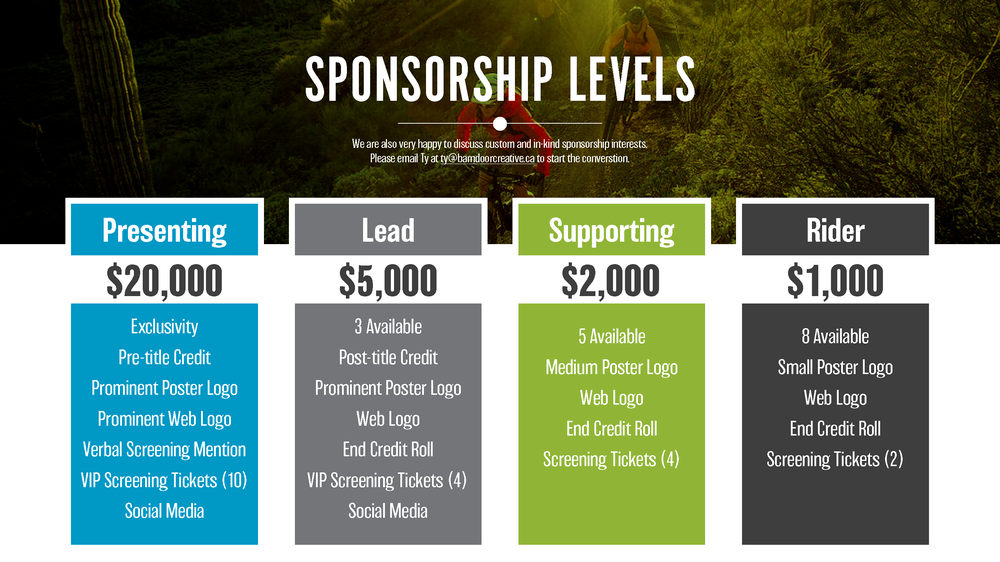
4. Sponsorship Levels
Many organizations organize opportunities into different investment tiers.
For example:
Presenting Sponsor
A premium level with deep brand integration and significant visibility.
Platinum Sponsor
A major partnership with extensive promotional and activation opportunities.
Gold Sponsor
A substantial investment level focused on meaningful exposure and audience engagement.
Silver Sponsor
A more accessible opportunity with targeted recognition and selected benefits.
Community Sponsor
A smaller investment designed for local businesses or organizations with limited budgets.
The labels can change.
The structure is what matters.
Each level should provide a meaningful increase in value.
Do not simply make the logo larger and add two social media posts every time the price increases.
A higher-level sponsorship should often create deeper participation.
More access.
Greater integration.
Stronger activation opportunities.
5. Investment Levels
A sponsorship package should clearly explain what different opportunities cost.
Ambiguity can create unnecessary obstacles.
Sponsors need to understand the financial commitment involved.
At the same time, pricing should reflect the actual value of your assets.
This is where organizations sometimes make one of two mistakes.
They price too low because they are afraid to ask for more.
Or they create prices based on guesswork rather than market value, audience quality, available assets, and sponsor objectives.
The right sponsorship investment is not based on how badly you need the money.
It is based on the value of the opportunity.
That is an important distinction.
6. Activation Opportunities
Activation is where sponsorship can become much more interesting.
A sponsor does not always want passive recognition.
They may want to do something.
Engage attendees.
Create an experience.
Demonstrate a product.
Generate content.
Support a cause.
Educate an audience.
Activation opportunities can include:
- Interactive experiences
- Branded lounges
- Workshops
- Product sampling
- Demonstrations
- Contests
- Content partnerships
- Educational programs
- VIP experiences
- Community initiatives
This is where creativity can add significant value.
A logo is visible.
An experience can be memorable.
The Anatomy of a Strong Sponsorship Package
Not every sponsorship package needs to look the same. A local charity event and a national conference should not necessarily use identical structures.
Still, a useful framework looks like this:
| Package Component | Why It Matters | Example |
|---|---|---|
| Opportunity overview | Establishes context | Annual conference with 8,000 attendees |
| Audience data | Demonstrates market access | 70% are business decision-makers |
| Sponsor benefits | Defines available assets | Branding, activation, content opportunities |
| Investment level | Clarifies commitment | $5,000, $15,000, $50,000 |
| Sponsorship rights | Defines what the sponsor can claim | Official category sponsor |
| Activation options | Encourages deeper engagement | Branded experience or workshop |
| Proof of performance | Builds confidence | Past attendance and engagement results |
| Custom opportunities | Allows flexibility | Tailored benefits for strategic partners |
| Contact information | Creates a clear next step | Sponsorship director or partnership manager |
This structure is not complicated.
That is intentional.
The best sponsorship packages are usually easy to understand.
My Lesson Learned: The Package That Had Everything Except What the Sponsor Wanted
I learned an important lesson about sponsorship packages through experience.
At one point, I believed that the more benefits I included, the stronger the package would be.
So I kept adding.
Another logo placement.
Another social media mention.
Another recognition opportunity.
Another ticket allocation.
The package looked impressive.
It was also crowded.
Then I had a conversation with a prospective sponsor that changed my perspective.
The company was not interested in many of the benefits I had spent so much time organizing.
They were not especially concerned about VIP tickets.
They did not need additional logo placement.
Their priority was direct engagement with a very specific audience segment.
And there it was.
The thing they cared about most was barely featured in my package.
I had been building a document around what I had available instead of organizing the opportunity around what sponsors might value.
That was a difficult lesson.
It was also useful.
Since then, I have looked at sponsorship packages differently.
I still believe in having clearly defined assets.
I still believe in structure.
But I have learned that the package should support the conversation, not control it.
Why Sponsorship Packages Make the Sales Process Easier
A good package creates efficiency.
Without one, every sponsor conversation may require you to explain your opportunity from the beginning.
That takes time.
It can also create inconsistency.
One sponsor hears about a particular benefit. Another does not. One receives a price quote based on instinct. Another receives a completely different number.
A structured package helps prevent that.
It gives your organization a baseline.
You know what assets are available.
You know which benefits are premium.
You know what inventory is limited.
You know what different investment levels represent.
This also makes internal management easier.
If you have multiple people selling sponsorships, a package provides a common framework.
But again, structure should not become rigidity.
The most effective sponsorship professionals know when to use the package and when to go beyond it.
Should Every Sponsor Receive the Same Package?
Usually, no.
The core package may remain the same, but the presentation should change based on the prospect.
A large national company may be interested in different opportunities than a local business.
A company trying to reach consumers may value something different from a company trying to recruit employees.
A financial institution may have different priorities from a technology company.
This is why sponsor research matters.
Before sending a package, consider:
- What does the company sell?
- Who are its customers?
- What audiences are important to its growth?
- What marketing objectives might it have?
- Does it support causes or initiatives similar to yours?
- What other sponsorships has it pursued?
- What would make your opportunity relevant?
Then position the package accordingly.
You do not have to rebuild the entire document.
You simply need to lead with relevance.
The Danger of Treating Sponsorship Packages Like Price Lists
This may be the most important warning.
A sponsorship package should not feel like a vending machine.
Insert money.
Receive benefits.
That is not how the strongest corporate partnerships work.
Companies increasingly want accountability. They want strategic alignment. They want to understand who they are reaching and what the partnership can accomplish.
Your package should communicate more than inventory.
It should communicate possibility.
For example, instead of saying:
$25,000 = logo, booth, tickets, and social media.
You might frame the opportunity around:
- Reaching a targeted audience
- Building direct relationships
- Demonstrating expertise
- Creating meaningful brand experiences
- Generating measurable engagement
The benefits still matter.
They simply become part of a larger business case.
How Many Sponsorship Packages Should You Offer?
For most organizations, three to five primary levels work well.
That provides choice without creating confusion.
You might offer:
- Premium Partner
- Major Partner
- Supporting Partner
- Community Partner
Or:
- Platinum
- Gold
- Silver
- Bronze
The names are less important than the distinctions.
Every level should answer a different need or represent a different degree of access and value.
Too many packages can create decision fatigue.
Too few can limit opportunities.
The ideal structure gives sponsors enough flexibility to find a reasonable starting point while keeping the decision process straightforward.
Custom Packages Can Create Bigger Opportunities
Sometimes the best sponsorship package is not a package at all.
It is a custom partnership.
Suppose a company wants to reach young entrepreneurs.
Your organization has access to that audience.
Instead of selling the company a standard sponsorship level, you could develop a custom initiative:
- A sponsored educational program
- A content partnership
- A branded mentoring series
- A dedicated audience experience
- A research project
- A multi-event partnership
The company receives something more relevant.
Your organization creates a potentially higher-value opportunity.
The audience receives something useful.
That is where sponsorship becomes more than a transaction.
The Best Sponsorship Package Is a Starting Point
So, what is a sponsorship package?
It is a structured collection of opportunities a company can access through a partnership with your organization, event, platform, or initiative.
It defines benefits.
It establishes investment levels.
It communicates available assets.
It makes the sponsorship process easier to understand.
But that is only the beginning.
A great sponsorship package does something more ambitious.
It helps a prospective sponsor imagine what could happen if the two organizations worked together.
That is the real test.
Not whether your package has attractive colors.
Not whether it includes Platinum, Gold, and Silver.
Not whether it contains 50 different benefits.
Ask yourself a more difficult question:
If a company removed your organization's name from the cover, would the package still make a convincing case for why this opportunity matters to a business?
If the answer is no, your package may need more than a redesign.
It may need a new strategy.
Because sponsors are not searching for more places to put their logos.
They are searching for opportunities that help them connect, communicate, engage, grow, and achieve measurable objectives.
Your sponsorship package should make that opportunity visible.
And then it should leave enough room for something even more valuable.
A conversation.
- Arts
- Business
- Computers
- Παιχνίδια
- Health
- Κεντρική Σελίδα
- Kids and Teens
- Money
- News
- Personal Development
- Recreation
- Regional
- Reference
- Science
- Shopping
- Society
- Sports
- Бизнес
- Деньги
- Дом
- Досуг
- Здоровье
- Игры
- Искусство
- Источники информации
- Компьютеры
- Личное развитие
- Наука
- Новости и СМИ
- Общество
- Покупки
- Спорт
- Страны и регионы
- World

 English
 Russian
 French
 Spanish
 Portuguese
 Deutsch
 Turkish
 Dutch
Dutch
 Italiano
 Arabic
 Romaian
 Portuguese (Brazil)