
What Is the Difference Between Offshoring and Outsourcing?
In today’s globalized business environment, companies are constantly seeking ways to improve efficiency, reduce costs, and focus on their core activities. Two commonly used strategies to achieve these goals are offshoring and outsourcing. Although these terms are often used interchangeably, they represent distinct concepts with different implications for how businesses operate.
Understanding the difference between offshoring and outsourcing is essential for making informed business decisions. Each strategy has its own advantages, risks, and use cases, and organizations often use them separately or in combination. This article provides a comprehensive explanation of both concepts, their differences, similarities, and strategic importance.
Definitions
What Is Offshoring?
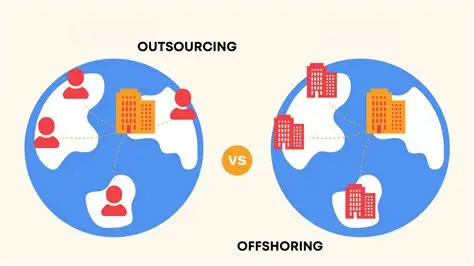
Offshoring refers to relocating business operations or processes to another country. The key aspect of offshoring is location—the work is performed outside the company’s home country.
Examples:
- Manufacturing products in a foreign country
- Opening a development center abroad
- Moving customer support operations overseas
Offshoring can be done either internally (own office) or externally (third-party provider).
What Is Outsourcing?
Outsourcing refers to contracting a third-party company to perform certain business tasks or services. The key aspect of outsourcing is who performs the work—an external organization.
Examples:
- Hiring a company to manage IT services
- Outsourcing payroll processing
- Using an external call center
Outsourcing can be domestic or international.
Key Difference: Location vs Ownership
The main difference between offshoring and outsourcing is:
- Offshoring = where the work is done (another country)
- Outsourcing = who does the work (external provider)
This distinction is fundamental and helps clarify how the two strategies differ.
Comparison Table
| Aspect | Offshoring | Outsourcing |
|---|---|---|
| Focus | Location | Ownership |
| Definition | Moving work to another country | Hiring an external company |
| Control | Higher (if in-house) | Lower (third-party) |
| Location | Always international | Domestic or international |
| Objective | Cost reduction, global talent | Efficiency, specialization |
| Flexibility | Moderate | High |
Types of Offshoring
Offshoring can take different forms:
1. Captive Offshoring
- Company sets up its own operations abroad
- Full control over processes
- Higher initial investment
2. Offshore Outsourcing
- Work is outsourced to a provider in another country
- Combines both offshoring and outsourcing
Types of Outsourcing
Outsourcing can also vary:
1. Onshore Outsourcing
- Work is outsourced within the same country
2. Nearshore Outsourcing
- Work is outsourced to a nearby country
3. Offshore Outsourcing
- Work is outsourced to a distant country
When Do Companies Use Offshoring?
Companies choose offshoring when they want:
- Lower labor and operational costs
- Access to global talent
- Expansion into international markets
- Continuous operations across time zones
Offshoring is often used for:
- Manufacturing
- IT development
- Customer service
When Do Companies Use Outsourcing?
Outsourcing is preferred when companies want to:
- Focus on core activities
- Reduce operational complexity
- Access specialized expertise
- Increase flexibility
Common outsourced functions include:
- IT services
- HR and payroll
- Marketing
- Customer support
Combining Offshoring and Outsourcing
Many organizations use both strategies together, known as offshore outsourcing.
Example:
A company hires a third-party firm in another country to handle customer service.
This approach provides:
- Cost savings from offshoring
- Efficiency from outsourcing
Advantages of Offshoring
1. Cost Savings
Lower wages and operational costs in foreign countries.
2. Access to Talent
Availability of skilled workers globally.
3. Market Expansion
Presence in international markets.
4. Scalability
Ability to expand operations quickly.
Disadvantages of Offshoring
1. Communication Challenges
Language and cultural differences.
2. Time Zone Issues
Coordination difficulties.
3. Political Risks
Changes in regulations or economic conditions.
Advantages of Outsourcing
1. Cost Efficiency
Reduced need for in-house resources.
2. Specialized Expertise
Access to experts in specific fields.
3. Flexibility
Easier to scale services up or down.
4. Focus on Core Business
Allows companies to concentrate on strategic activities.
Disadvantages of Outsourcing
1. Loss of Control
Less direct oversight of operations.
2. Dependency on Vendors
Reliance on external providers.
3. Quality Concerns
Potential inconsistencies in service quality.
Impact on Knowledge Capital
Both offshoring and outsourcing affect knowledge capital:
Positive Effects
- Access to global expertise
- Increased knowledge diversity
- Opportunities for innovation
Negative Effects
- Risk of knowledge leakage
- Loss of internal expertise
- Challenges in knowledge sharing
Organizations must manage knowledge carefully when using these strategies.
Strategic Considerations
When choosing between offshoring and outsourcing, companies should consider:
- Nature of the task
- Level of control required
- Cost vs quality trade-offs
- Data security and confidentiality
- Long-term business goals
Real-World Examples
Offshoring Example
A company opens its own software development center in another country.
Outsourcing Example
A business hires a local firm to handle payroll processing.
Combined Example
A company outsources IT support to a provider located overseas.
Future Trends
1. Growth of Remote Work
Remote work reduces the need for physical relocation.
2. Increased Automation
AI may replace some outsourced and offshored tasks.
3. Hybrid Models
Companies will combine onshore, offshore, and outsourced operations.
4. Focus on Knowledge Work
More high-value tasks are being offshored and outsourced.
Best Practices
To use these strategies effectively, organizations should:
- Clearly define goals
- Choose reliable partners
- Invest in communication tools
- Protect intellectual property
- Monitor performance regularly
Conclusion
Offshoring and outsourcing are powerful strategies that help organizations improve efficiency, reduce costs, and access global talent. While they are often confused, the key difference lies in their focus: offshoring is about where work is done, while outsourcing is about who does the work.
Both approaches offer significant benefits but also come with risks that must be carefully managed. In today’s interconnected world, many companies use a combination of both strategies to maximize their advantages.
Understanding the differences between offshoring and outsourcing enables organizations to make better strategic decisions and effectively manage their operations in the global economy.
- Arts
- Business
- Computers
- Jogos
- Health
- Início
- Kids and Teens
- Money
- News
- Personal Development
- Recreation
- Regional
- Reference
- Science
- Shopping
- Society
- Sports
- Бизнес
- Деньги
- Дом
- Досуг
- Здоровье
- Игры
- Искусство
- Источники информации
- Компьютеры
- Личное развитие
- Наука
- Новости и СМИ
- Общество
- Покупки
- Спорт
- Страны и регионы
- World

 English
 Russian
 French
 Spanish
 Deutsch
 Turkish
 Dutch
Dutch
 Italiano
 Arabic
 Romaian
 Portuguese (Brazil)
 Greek
Greek
