
How to create a goal-setting plan?
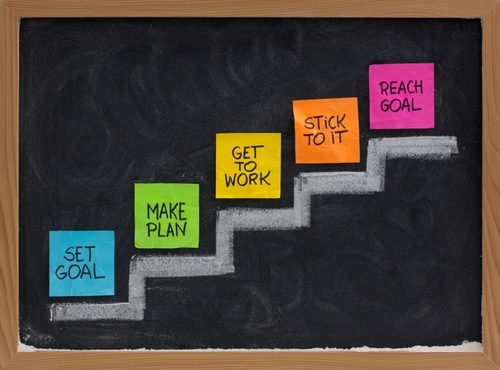
Creating a goal-setting plan is the bridge between a vague "I want" and a concrete "I did." Most plans fail because they are too top-heavy—all vision and no execution. A successful plan is a living system that accounts for both your highest aspirations and your daily reality.
Think of this process as engineering your own success.
The 4-Phase Planning Architecture
Phase 1: The Vision Audit (The "North Star")
Before you decide how to get there, you must be certain of the destination. A plan built on a "false" goal will lead to a successful arrival in a place you don't want to be.
-
The "Three-Why" Test: Ask yourself why you want this goal. Then ask "Why?" to that answer, and once more. If the core reason doesn't resonate with your values, the plan will fail.
-
Outcome Visualization: Write a single paragraph describing exactly what your life looks like once the goal is achieved. This is your "Done" state.
Phase 2: The Structural Breakdown (Reverse Engineering)
A goal is just a project that hasn't been deconstructed yet. To create a plan, you must work backward from the finish line to the present moment.
-
Milestones: These are your "checkpoints." If your goal is a 6-month journey, what needs to be true at the end of month 1, 3, and 5?
-
Projects: What specific "blocks" of work are required to hit those milestones? (e.g., "Research," "Drafting," "Review").
-
Tasks: These are the atomic units of your plan. They must be physical, actionable, and take less than two hours.
Phase 3: The Integration (The Daily Log)
A plan that lives only in a spreadsheet is a dead plan. You must integrate it into the rhythm of your actual life.
-
Time Blocking: Look at your week. Where is the "Real Estate" for this goal? Block off non-negotiable windows in your calendar.
-
The "Rule of Three": Every day, identify the three specific tasks from your plan that move the needle. Do these first.
-
Environmental Design: Set up your workspace so the "on-ramp" to your first task is frictionless.
The Planning Template: From Vision to Action
| Component | Definition | Example |
| The Goal | The specific, verifiable outcome. | "Self-publish a 30,000-word e-book." |
| The Why | The intrinsic motivation. | "To establish authority in my field." |
| The Milestone | The 30-day checkpoint. | "Complete a full rough draft by June 1st." |
| The Project | A thematic block of work. | "Chapter 1: The Fundamentals." |
| The Task | The next physical action. | "Write 500 words on the 'intro' section." |
Phase 4: The Calibration (The Weekly Review)
The greatest plans are iterative. No plan survives first contact with reality without adjustment.
-
The Sunday Audit: Every week, sit down with your notebook and ask:
-
What did I finish?
-
Where did I hit friction?
-
What needs to change for next week?
-
-
The Pivot: If a task keeps getting moved from one day to the next, it’s either too big or you don't actually want to do it. Shrink it or delete it.
The Lesson of the "Perfect Plan"
I once spent a full month creating a "perfect" 12-month plan for a career transition. It was a masterpiece of color-coding and Gantt charts. I felt like a genius.
By week three of the actual work, the plan was useless. A family emergency happened, a software tool I needed was discontinued, and I realized I hated one of the core tasks I’d assigned myself. I felt like a failure because I couldn't follow my own "perfect" map.
I learned that planning is a verb, not a noun. I stopped trying to predict the next year and started planning the next week with high intensity, while keeping the "year" as a loose direction.
The goal of a plan isn't to be right; it's to be in motion.
The Provocation: Is Your Plan a Safety Blanket?
Many of us use planning as a form of "productive procrastination." As long as we are planning, we are safe from the possibility of failure. We feel the "high" of achievement without doing any of the work.
If your plan is more than two pages long, you are likely over-thinking it.
Stop looking for the perfect strategy. A "B-grade" plan that you actually execute is infinitely more valuable than an "A-grade" plan that sits in a drawer.
What is the one task you can do in the next 10 minutes to prove your plan is actually alive?
- Arts
- Business
- Computers
- Oyunlar
- Health
- Home
- Kids and Teens
- Money
- News
- Personal Development
- Recreation
- Regional
- Reference
- Science
- Shopping
- Society
- Sports
- Бизнес
- Деньги
- Дом
- Досуг
- Здоровье
- Игры
- Искусство
- Источники информации
- Компьютеры
- Личное развитие
- Наука
- Новости и СМИ
- Общество
- Покупки
- Спорт
- Страны и регионы
- World

 English
 Russian
 French
 Spanish
 Portuguese
 Deutsch
 Dutch
Dutch
 Italiano
 Arabic
 Romaian
 Portuguese (Brazil)
 Greek
Greek