
Who controls the economy?
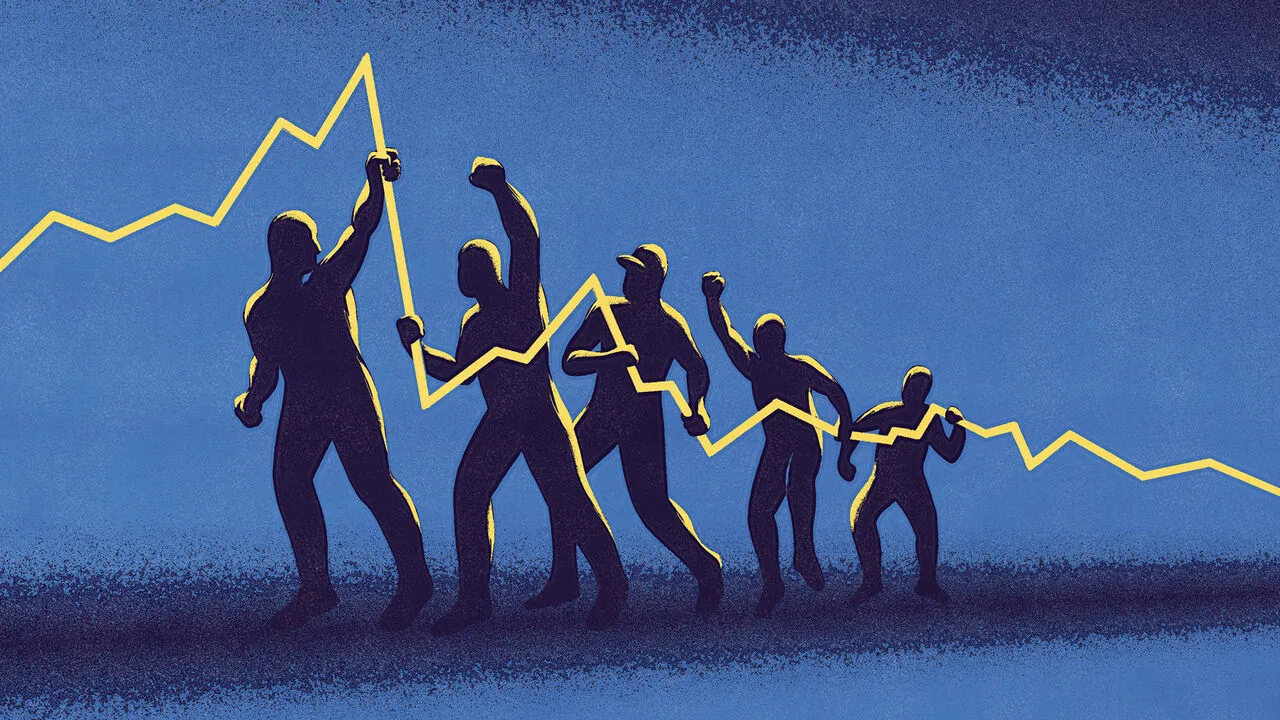
Who Controls the Economy?
There is a comforting fiction taught in modern democracies: the economy is managed. Somewhere, in marble buildings populated by economists with equations and polished shoes, serious people supposedly pull levers that guide prosperity with the precision of an engineer operating a turbine. Recessions are “stimulated” away. Inflation is “targeted.” Employment is “optimized.” Growth is “managed.”
It is a beautiful fantasy. It is also wrong.
No individual controls the economy. No committee controls it either. Not presidents, not central bankers, not billionaires, not corporations. The economy is not a machine. It is the cumulative outcome of billions of voluntary exchanges, preferences, time horizons, incentives, and errors unfolding simultaneously across society. The tragedy of modern economic thought is not merely that it misunderstands economics. It is that it mistakes coordination for control.
And yet, despite this reality, there are institutions that wield extraordinary influence over economic life. Influence is not the same as control, but in the modern fiat era, influence has swollen to proportions unimaginable even a century ago. To understand who controls the economy, one must first understand what the economy actually is.
The Economy Is Human Cooperation
An economy is not money. It is not GDP statistics scrolling across financial television. It is not a stock market index inflated by monetary expansion.
An economy is the structure of human cooperation under conditions of scarcity.
Every loaf of bread on a supermarket shelf represents a chain of coordination so vast that no single human mind could possibly comprehend it in full. Farmers cultivate wheat using machinery assembled from components mined across continents. Fuel extracted in one hemisphere powers tractors in another. Shipping routes, insurance contracts, warehouse logistics, software systems, banking networks, and labor markets converge invisibly to produce something so ordinary that most consumers barely notice it.
The miracle is not government planning. The miracle is that strangers cooperate at all.
This realization permanently altered how I viewed economic policy. Years ago, during a prolonged currency crisis in a developing country I visited, I watched store shelves empty within days after price controls were imposed. Politicians appeared on television blaming “greedy merchants.” Yet the merchants themselves were desperately trying to restock inventories in a collapsing monetary environment. The issue was not morality. It was incentives.
When prices could no longer communicate scarcity truthfully, economic coordination disintegrated.
That experience taught me a lesson more valuable than any university lecture: economies are governed primarily by information encoded in prices, not by commands issued from ministries.
The Persistent Myth of Economic Central Planning
The twentieth century was essentially one giant experiment in centralized economic control.
It failed everywhere.
The Soviet Union attempted perhaps the most ambitious economic planning project in history. Bureaucrats determined production quotas for steel, wheat, housing, and transportation. Enormous statistical agencies collected mountains of data. Yet despite controlling vast territory and immense natural resources, the system could not solve the most basic problem in economics: how to allocate scarce resources efficiently without market prices.
The result was absurdity on an industrial scale.
Factories met quotas by producing unusable goods. Stores lacked essentials while warehouses overflowed with unwanted inventory. Innovation stagnated because bureaucracies optimize for political obedience, not entrepreneurial discovery.
The collapse was inevitable because no committee can replace decentralized price signals emerging from millions of individuals making independent decisions.
This remains true today, although modern governments employ subtler methods.
Central Banks: The Closest Thing to Economic Rulers
If one institution comes closest to exercising broad control over the modern economy, it is the central bank.
Not because central bankers are omnipotent, but because they control money itself.
Money is the nervous system of economic activity. Alter the supply of money, and one alters incentives throughout society. Interest rates influence borrowing. Borrowing influences investment. Investment influences employment, asset prices, consumption patterns, and political stability.
This is why modern economies increasingly revolve around central bank decisions rather than productive output.
When the Federal Reserve lowers interest rates, it does not merely encourage borrowing. It reshapes the time preferences of society. Savings become less rewarding. Debt becomes more attractive. Speculation flourishes. Asset owners benefit first because newly created money enters financial markets before reaching wage earners.
The consequences are profound.
Low interest rates encourage governments to accumulate debts previously unimaginable. Corporations issue cheap debt to finance stock buybacks rather than productive investment. Real estate prices soar beyond the reach of ordinary families. Financial engineering becomes more profitable than manufacturing.
And yet central bankers insist they are merely “stabilizing” the economy.
Stability, curiously enough, now requires perpetual intervention.
A Comparison of Economic Power Centers
| Institution | Primary Source of Power | What They Influence | Key Limitation |
|---|---|---|---|
| Central Banks | Money creation and interest rates | Credit markets, inflation, asset prices | Cannot create real productivity |
| Governments | Taxation and regulation | Incentives, redistribution, public spending | Constrained by political backlash and debt |
| Corporations | Capital allocation and production | Employment, innovation, supply chains | Dependent on consumer demand |
| Consumers | Spending decisions | Market demand and business survival | Fragmented and uncoordinated |
| Financial Institutions | Credit distribution | Investment flows and liquidity | Vulnerable to monetary policy |
| Entrepreneurs | Innovation and risk-taking | Productivity growth and competition | Subject to regulation and market conditions |
The important observation here is not who possesses power, but how dispersed that power truly is.
Even the largest institutions remain constrained by incentives they cannot fully control.
Governments Control More Than They Admit
Modern governments rarely nationalize industries outright anymore. They learned that direct control often produces visible catastrophe. Instead, they govern indirectly through regulation, taxation, subsidies, and monetary partnerships with central banks.
This approach is politically elegant because it preserves the illusion of free markets while heavily shaping outcomes beneath the surface.
Consider housing markets.
Politicians routinely blame rising home prices on speculators or insufficient regulation. Yet many housing crises are themselves consequences of monetary policy combined with zoning restrictions, artificially suppressed interest rates, and government-backed mortgage systems.
The same pattern appears in higher education. Easy credit inflates tuition. Universities expand administrative bureaucracies. Students assume lifelong debt burdens. Policymakers then express shock at soaring education costs created largely by the incentives they engineered.
Intervention produces distortions. Distortions justify further intervention. The cycle continues.
Eventually the economy begins to resemble a patient kept alive through constant injections rather than genuine health.
Billionaires and Corporations: Powerful but Constrained
Popular political rhetoric often portrays billionaires as puppet masters controlling the global economy. This interpretation misunderstands both wealth and markets.
Wealth in a market economy is generally downstream from consumer choice.
A corporation becomes enormous because millions voluntarily purchase its products or services. The moment consumers stop buying, corporate dominance evaporates astonishingly quickly. History is littered with once-invincible firms that collapsed because they failed to adapt.
What corporations do possess is influence over political systems.
Large firms lobby governments because regulatory complexity often benefits incumbents. Massive corporations can absorb compliance costs that destroy smaller competitors. Thus regulation, supposedly designed to restrain corporate power, frequently entrenches it instead.
This is one of the great ironies of modern capitalism: the fusion of state power and corporate privilege often emerges from attempts to limit corporate power itself.
True free competition is uncomfortable because it permits failure. Political systems dislike failure because failure creates instability. Therefore governments frequently rescue large institutions from market consequences.
The result is not capitalism in its pure form, but something closer to managed corporatism.
Consumers Quietly Shape Everything
The most underestimated economic force is the ordinary consumer.
Not because consumers act collectively with strategic intent, but because market systems ultimately respond to aggregated preferences. Every purchase communicates information. Every refusal to buy communicates information as well.
This decentralized process disciplines producers far more effectively than most regulatory agencies.
A restaurant serving terrible food does not require a parliamentary inquiry to collapse. Consumers punish incompetence automatically through non-participation.
This feedback mechanism is extraordinarily powerful precisely because it is voluntary.
Yet consumers themselves are heavily influenced by monetary conditions. Cheap credit encourages short-term consumption over long-term savings. Inflation distorts purchasing decisions by punishing delayed gratification. In many ways, monetary policy reshapes cultural behavior itself.
Societies with stable money tend to reward patience and capital accumulation. Societies with unstable money reward speculation and immediacy.
This is not accidental.
The Hidden Controller: Incentives
If one insists on identifying the true controller of the economy, the answer is neither politicians nor bankers.
It is incentives.
Human beings respond predictably to incentive structures even when policymakers do not anticipate the consequences. Raise taxes on production, and production declines. Subsidize debt, and debt expands. Inflate the currency, and people flee toward hard assets.
Economics is fundamentally the study of unintended consequences emerging from human action under scarcity.
This explains why economic planning repeatedly fails. Planners assume society behaves mechanically. Real human beings behave adaptively.
Change the rules, and people change their behavior.
Often in ways experts never predicted.
Why Economic “Control” Always Breaks Down
The fatal flaw in economic management is epistemological: knowledge is decentralized.
No authority possesses sufficient information to coordinate billions of constantly changing preferences and resource allocations in real time. Prices emerging from free exchange communicate information more efficiently than bureaucratic directives ever could.
This insight, articulated most powerfully by economists like Friedrich Hayek, remains devastating to central planning fantasies.
Economic order emerges spontaneously from decentralized interaction.
Attempts to dominate that process often produce fragility rather than stability.
One sees this clearly in financial crises. Years of artificially suppressed interest rates encourage excessive leverage. Asset bubbles expand. Policymakers celebrate prosperity. Then reality intrudes. Malinvestments collapse simultaneously, revealing that apparent stability was merely postponed volatility.
The intervention designed to eliminate recessions frequently amplifies them.
The Provocative Truth
So who controls the economy?
No one fully does.
That is both terrifying and liberating.
The economy is not a kingdom ruled from above. It is an emergent phenomenon arising from millions of individuals pursuing their own interests within institutional constraints. Governments influence it. Central banks distort it. Corporations navigate it. Consumers animate it. Entrepreneurs transform it.
But none command it absolutely.
The more aggressively institutions attempt to impose centralized control, the more brittle the system often becomes. Genuine prosperity emerges less from management than from allowing free individuals to coordinate voluntarily through stable rules, sound money, and open competition.
This conclusion is profoundly unfashionable because modern political systems derive legitimacy from the promise of control. Citizens are told that experts can engineer prosperity if granted sufficient authority. Yet history repeatedly demonstrates the opposite.
Prosperity is rarely engineered.
It is cultivated.
And cultivation requires humility — the recognition that no economist, politician, or billionaire is intelligent enough to orchestrate an entire civilization from above.
The economy is ultimately controlled by reality itself: scarcity, incentives, human action, and time.
Everything else is commentary.
- Arts
- Business
- Computers
- Jeux
- Health
- Domicile
- Kids and Teens
- Argent
- News
- Personal Development
- Recreation
- Regional
- Reference
- Science
- Shopping
- Society
- Sports
- Бизнес
- Деньги
- Дом
- Досуг
- Здоровье
- Игры
- Искусство
- Источники информации
- Компьютеры
- Личное развитие
- Наука
- Новости и СМИ
- Общество
- Покупки
- Спорт
- Страны и регионы
- World

 English
 Russian
 Spanish
 Portuguese
 Deutsch
 Turkish
 Dutch
Dutch
 Italiano
 Arabic
 Romaian
 Portuguese (Brazil)
 Greek
Greek