
Retail KPIs Explained: The Numbers That Matter—and the Ones That Merely Make Noise
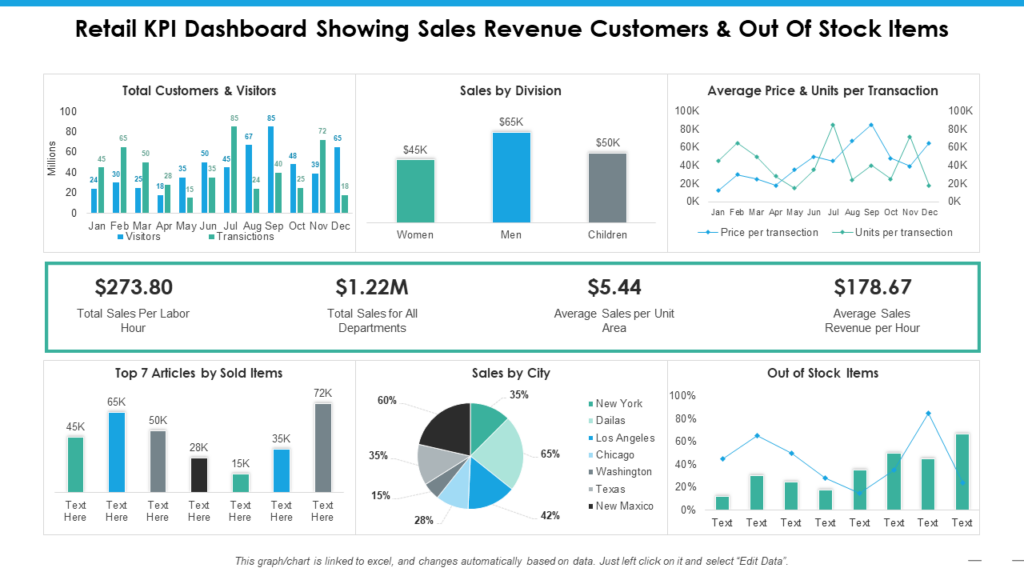
Retailers love metrics.
They collect them, display them on dashboards, discuss them in meetings, and occasionally worship them. Yet for all the enthusiasm surrounding retail KPIs (Key Performance Indicators), many organizations still struggle with a deceptively simple question: Which numbers actually matter?
That question sounds straightforward until you walk into a modern retail environment. Suddenly, you're surrounded by a dizzying array of measurements: traffic, conversion, basket size, inventory turnover, customer lifetime value, gross margin return on inventory investment, net promoter score, return rates, fulfillment costs, and dozens more.
The temptation is to track everything.
The problem is that tracking everything often means understanding nothing.
Retail KPIs are valuable not because they provide numbers, but because they provide insight. The best KPIs tell a story. Better yet, they tell a story about customers. And as retail has evolved—from department stores to direct-to-consumer brands, from physical aisles to endless digital shelves—the most successful retailers have learned a crucial lesson: performance metrics must connect operational efficiency to customer value.
The KPI itself is never the destination. It's merely a signpost.
Why Retail KPIs Matter More Than Ever
Retail has become wonderfully complicated.
A customer might discover a product on social media, research it on a mobile app, inspect it in a store, purchase it online, and return it through a third-party location. Every touchpoint generates data. Every interaction leaves a trail.
The result is unprecedented visibility—and unprecedented confusion.
Years ago, I sat in a meeting with a retail executive who proudly announced that website traffic had increased by 40%. The room nodded approvingly. Then someone asked a simple question: "Did sales increase?"
Silence.
Traffic had surged. Revenue had barely moved.
The lesson was memorable because it exposed a common mistake. A KPI without context is merely a statistic. Retail success comes not from measuring activity but from measuring outcomes.
The most effective KPIs illuminate the relationship between customer behavior and business performance. They reveal whether a retailer is creating value, capturing value, or slowly eroding it.
The Four Categories of Retail KPIs
Most retail metrics fall into four broad categories:
1. Sales Performance KPIs
These metrics answer the most immediate question: Are we generating revenue efficiently?
Key measurements include:
- Total sales revenue
- Comparable store sales (same-store sales)
- Average transaction value (ATV)
- Units per transaction (UPT)
- Sales per square foot
Sales metrics are often the first numbers executives examine because they provide a quick pulse check. Yet revenue alone can be misleading. A retailer can increase sales while simultaneously reducing profitability through excessive discounting.
That's why smart retailers rarely evaluate revenue in isolation.
2. Customer KPIs
Customer-focused metrics reveal whether shoppers are merely buying—or actually building relationships with the brand.
Important measures include:
- Customer acquisition cost (CAC)
- Customer lifetime value (CLV)
- Repeat purchase rate
- Retention rate
- Net Promoter Score (NPS)
The distinction matters.
A retailer acquiring customers at $120 each who generate only $90 in lifetime value isn't building a business. It's financing a problem.
3. Inventory KPIs
Inventory remains one of retail's most fascinating balancing acts.
Too much inventory ties up capital. Too little inventory creates stockouts and frustrated customers.
Critical inventory metrics include:
- Inventory turnover
- Sell-through rate
- Stockout rate
- Days inventory outstanding
- Gross Margin Return on Inventory Investment (GMROII)
Retail history is littered with examples of companies that confused inventory accumulation with growth. Inventory should move. When it doesn't, financial consequences tend to arrive with remarkable punctuality.
4. Operational KPIs
Operational metrics evaluate how efficiently the organization delivers value.
Examples include:
- Order fulfillment time
- Labor productivity
- Return rate
- Shrinkage rate
- Cost per order
Customers may never see these metrics directly. They certainly feel their effects.
A retailer with exceptional operational performance often appears effortless to consumers. Packages arrive quickly. Shelves remain stocked. Returns proceed smoothly. Behind that seamless experience lies disciplined KPI management.
The Retail KPI Comparison Table
The following table highlights some of the most important retail KPIs and what they reveal.
| KPI | Formula | What It Measures | Strong Performance Signals |
|---|---|---|---|
| Conversion Rate | Purchases ÷ Visitors | Ability to turn traffic into sales | Rising conversions without excessive discounting |
| Average Transaction Value | Revenue ÷ Transactions | Customer spending per purchase | Increasing basket size and premium purchases |
| Inventory Turnover | Cost of Goods Sold ÷ Average Inventory | Inventory efficiency | Faster movement with maintained margins |
| Customer Lifetime Value | Average Purchase Value × Frequency × Retention | Long-term customer value | CLV significantly exceeds acquisition cost |
| Customer Acquisition Cost | Marketing Spend ÷ New Customers | Cost to gain customers | Stable or declining CAC |
| Gross Margin | (Revenue - COGS) ÷ Revenue | Profitability of products sold | Consistent margins despite competition |
| Sell-Through Rate | Units Sold ÷ Units Received | Inventory effectiveness | Strong product demand and forecasting |
| Return Rate | Returns ÷ Total Sales | Product satisfaction and fit | Lower rates without hurting sales |
| Sales per Square Foot | Revenue ÷ Selling Space | Store productivity | Efficient use of physical footprint |
| Net Promoter Score | Promoters - Detractors | Customer advocacy | Strong brand loyalty and word-of-mouth |
Notice something interesting.
Every KPI in the table measures more than performance. Each one measures a relationship: between traffic and purchases, inventory and demand, marketing spend and customer value.
Retail is fundamentally a business of relationships. The best KPIs simply quantify them.
The KPI Trap: When Good Metrics Become Bad Decisions
One of the most counterintuitive realities in retail is that improving a KPI can sometimes harm the business.
Consider conversion rate.
Suppose a retailer raises conversion by offering steep discounts across its assortment. Conversion increases. Revenue may even rise temporarily.
Margins collapse.
Profitability suffers.
The KPI improved; the business weakened.
This phenomenon occurs because metrics rarely operate independently. Retail is an interconnected system. Pull one lever and another moves.
A retailer focused exclusively on inventory turnover may reduce stock levels too aggressively, increasing stockouts. A company obsessed with lowering acquisition costs may sacrifice customer quality. A business determined to maximize average transaction value may inadvertently create friction during checkout.
The sophisticated retailer understands tradeoffs.
Metrics are conversations, not verdicts.
Why Customer-Centric KPIs Are Gaining Influence
For decades, retail measurement revolved primarily around transactions.
Today, the emphasis increasingly centers on customers.
There's a compelling reason for this shift.
Transactions are moments. Customers are assets.
A retailer that understands customer behavior gains advantages that extend far beyond a single purchase. It can personalize experiences, optimize assortments, improve forecasting, and strengthen loyalty.
This is why metrics such as retention rate and customer lifetime value have become boardroom priorities.
Imagine two brands.
Brand A acquires 100,000 customers annually but retains only 20%.
Brand B acquires 60,000 customers but retains 75%.
At first glance, Brand A appears stronger.
Over time, Brand B often wins.
Retention compounds. Acquisition rarely does.
The mathematics are powerful. The strategic implications are even more powerful.
Omnichannel Retail Requires Omnichannel KPIs
The old distinction between online and offline retail feels increasingly artificial.
Customers certainly don't think in channels.
They think in experiences.
Yet many retailers still measure performance through channel-specific lenses. E-commerce teams optimize online conversions. Store teams optimize foot traffic. Marketing teams focus on digital engagement.
The customer experiences all of it simultaneously.
This creates a measurement challenge.
Modern retailers need KPIs that capture customer journeys across touchpoints. Metrics such as omnichannel customer value, cross-channel conversion, and blended customer acquisition costs are becoming essential.
Otherwise, organizations risk optimizing individual channels while degrading the overall customer experience.
And customers are remarkably indifferent to internal organizational charts.
The Most Underappreciated Retail KPI
If I had to nominate one metric that deserves more attention, it would be customer lifetime value.
Not because it's new.
Not because it's complicated.
Because it forces a longer perspective.
Retailers often make decisions under intense short-term pressure. Quarterly targets loom. Monthly reports arrive. Weekly sales updates dominate conversations.
Customer lifetime value changes the frame.
Instead of asking, "How much revenue did this customer generate today?" it asks, "How much value will this relationship create over time?"
That subtle shift can transform decisions regarding pricing, loyalty programs, customer service investments, and marketing allocation.
The best retailers aren't maximizing transactions.
They're maximizing relationships.
How to Build a Smarter Retail KPI Dashboard
A useful dashboard does not contain every metric available.
It contains the right metrics.
Three principles help:
Focus on Outcomes
Track indicators directly tied to strategic objectives.
More data does not automatically produce more clarity.
Balance Leading and Lagging Indicators
Revenue is a lagging indicator.
Customer engagement often functions as a leading indicator.
Both matter.
One explains what happened. The other hints at what may happen next.
Connect Metrics Across Functions
Sales, inventory, marketing, and customer experience should not exist in separate measurement silos.
The strongest insights often emerge from the intersections.
For example, rising acquisition costs combined with declining retention rates may reveal a deeper customer value problem long before revenue declines become visible.
The Real Purpose of Retail KPIs
The obsession with metrics occasionally obscures a larger truth.
Retail is not ultimately about numbers.
It is about people.
People searching for convenience. People seeking inspiration. People solving problems. People expressing identity through what they buy.
KPIs matter because they help retailers serve those people more effectively.
When used wisely, metrics reveal patterns that human intuition alone might miss. When used poorly, they create a false sense of certainty and encourage optimization detached from customer reality.
That distinction has never been more important.
Conclusion: Measure What Creates Value, Not What Creates Activity
Retail leaders face no shortage of data.
The challenge is discernment.
Every KPI tells a story, but not every story deserves equal attention. Traffic without conversion, inventory without demand, acquisition without retention—these metrics can create the illusion of progress while masking deeper weaknesses.
The retailers that thrive are rarely the ones with the largest dashboards. They are the ones that understand which numbers signal genuine value creation. They know that a metric is useful only when it sharpens decision-making and deepens customer understanding.
The future of retail will undoubtedly generate even more data, more dashboards, and more sophisticated analytics. Yet the central question will remain remarkably stable: Does this KPI help us create better experiences and stronger customer relationships?
If the answer is yes, measure it relentlessly.
If the answer is no, the number may be interesting—but it is probably not important.
- Arts
- Business
- Computers
- Juegos
- Health
- Home
- Kids and Teens
- Money
- News
- Personal Development
- Recreation
- Regional
- Reference
- Science
- Shopping
- Society
- Sports
- Бизнес
- Деньги
- Дом
- Досуг
- Здоровье
- Игры
- Искусство
- Источники информации
- Компьютеры
- Личное развитие
- Наука
- Новости и СМИ
- Общество
- Покупки
- Спорт
- Страны и регионы
- World

 English
 Russian
 French
 Portuguese
 Deutsch
 Turkish
 Dutch
Dutch
 Italiano
 Arabic
 Romaian
 Portuguese (Brazil)
 Greek
Greek
