
What Is SaaS SEO?
There is a moment every SaaS founder eventually experiences.
Traffic stalls.
The product improves. Features multiply. The sales team works harder. Marketing publishes more content. Yet the growth curve begins to flatten.
The instinctive response is often to spend more.
More advertising.
More sponsorships.
More campaigns.
Sometimes that works.
More often, it creates a dependency. The moment spending slows, so does growth.
Then another company appears. It seems to be everywhere. Every question searched. Every software comparison. Every how-to guide. Every category page.
The company is not necessarily larger.
It is simply easier to find.
That distinction reveals the power of SaaS SEO.
Search engine optimization for software companies is frequently described as a traffic acquisition strategy. Technically, that is true.
But it is also incomplete.
The most successful SaaS companies do not use SEO merely to attract visitors. They use it to build an entire demand-generation engine—one that educates prospects, establishes credibility, reduces acquisition costs, and compounds in value over time.
In other words, SaaS SEO is less about rankings than relationships.
The rankings are simply evidence that those relationships are forming.
Defining SaaS SEO
SaaS SEO refers to the process of optimizing a Software-as-a-Service company's website and digital assets to increase visibility in search engines and attract qualified organic traffic.
The objective sounds straightforward.
Yet SaaS SEO differs significantly from SEO for e-commerce businesses, publishers, local companies, or traditional B2B organizations.
Software buyers rarely purchase immediately.
Their journey is longer.
More analytical.
More layered.
A prospect might search:
- How to improve team collaboration
- Best project management software
- Asana alternatives
- Project management software pricing
Those four searches represent four different stages of intent.
Each requires a different response.
Effective SaaS SEO aligns content with those varying stages of customer decision-making.
The goal is not simply attracting clicks.
It is guiding prospects toward confidence.
Why SaaS SEO Matters
Many acquisition channels disappear the moment spending stops.
SEO behaves differently.
A well-ranked article published today may continue generating traffic months or even years later.
That characteristic makes SEO unusually valuable within SaaS business models.
Consider the economics.
A software company acquires a customer through paid advertising.
The company pays for every click.
Every lead.
Every impression.
Now imagine acquiring that same customer through organic search.
The acquisition cost often decreases dramatically.
The customer lifetime value remains unchanged.
The math becomes attractive very quickly.
This explains why some of the most successful SaaS companies invest heavily in search visibility.
SEO creates leverage.
And leverage has a habit of accumulating.
The Unique Challenges of SaaS SEO
At first glance, SEO appears universal.
Keywords.
Content.
Links.
Technical optimization.
Yet SaaS introduces additional complexity.
Software purchases involve uncertainty.
Prospective buyers are evaluating solutions rather than products.
They are often researching problems before researching vendors.
This creates an unusual challenge.
The highest-value prospects frequently begin with informational searches.
Not transactional ones.
For example:
Someone searching “customer churn reduction strategies” may eventually purchase retention software.
Someone searching “sales forecasting template” may eventually adopt a CRM platform.
The connection exists.
But it unfolds gradually.
Consequently, SaaS SEO requires patience and strategic sequencing.
Understanding Search Intent in SaaS
Search intent sits at the center of every successful SaaS SEO strategy.
Without it, rankings become irrelevant.
Visitors arrive.
Conversions do not.
Generally speaking, SaaS search intent falls into four categories.
Informational Intent
The prospect seeks knowledge.
Examples include:
- What is customer churn?
- How does workflow automation work?
- Sales forecasting best practices
These searches occur early in the buyer journey.
The objective is education.
Commercial Investigation
The prospect begins evaluating solutions.
Examples include:
- Best CRM software
- Top help desk platforms
- Marketing automation tools comparison
Intent increases significantly.
Evaluation begins.
Navigational Intent
The user searches for a specific company or product.
Examples include:
- HubSpot pricing
- Salesforce login
- Slack integrations
Brand awareness already exists.
Transactional Intent
The prospect approaches a decision.
Examples include:
- Buy payroll software
- CRM free trial
- Accounting software demo
These keywords often generate the highest conversion rates.
Yet they also tend to be the most competitive.
The strongest SaaS SEO programs target all four categories simultaneously.
The SaaS SEO Content Framework
Content serves as the primary vehicle through which SaaS companies compete in search.
But not all content contributes equally.
Successful organizations typically build content ecosystems rather than isolated articles.
These ecosystems often include:
Educational Content
Blog posts addressing customer challenges.
Examples:
- How to reduce employee turnover
- Customer onboarding strategies
- Revenue forecasting methods
Educational content attracts top-of-funnel traffic.
Product-Led Content
Content directly connected to software functionality.
Examples:
- Workflow automation examples
- CRM implementation guides
- Customer support automation techniques
This content bridges education and product relevance.
Comparison Content
Highly valuable for evaluation-stage buyers.
Examples:
- Salesforce vs HubSpot
- Zendesk alternatives
- Best project management software
Intent is often exceptionally strong.
Use Case Pages
Focused on specific industries, roles, or problems.
Examples:
- CRM for real estate
- Accounting software for startups
- HR software for healthcare organizations
These pages improve relevance and conversion rates.
Together, these assets create a comprehensive search presence.
Comparing SaaS SEO Content Types
Not all content serves the same purpose.
The best SaaS companies understand the distinct role each content category plays.
| Content Type | Funnel Stage | Traffic Potential | Conversion Potential | Primary Goal |
|---|---|---|---|---|
| Educational Blogs | Awareness | Very High | Low-Medium | Build visibility |
| Industry Guides | Awareness/Consideration | High | Medium | Establish authority |
| Comparison Pages | Consideration | Medium | Very High | Influence evaluation |
| Alternative Pages | Consideration | Medium | Very High | Capture competitor demand |
| Product Pages | Conversion | Medium | Very High | Drive signups |
| Use Case Pages | Consideration | Medium | High | Increase relevance |
| Case Studies | Evaluation | Lower | Very High | Build trust |
| Knowledge Base Content | Retention/SEO | High | Medium | Support users and rankings |
The most successful SEO strategies balance volume and intent.
Traffic alone is insufficient.
Conversion alone limits scale.
Both matter.
Technical SEO in SaaS
Content often receives the spotlight.
Technical SEO quietly determines whether that content can perform.
Many SaaS websites face unique technical challenges.
Examples include:
- Large numbers of product pages
- Dynamic application environments
- JavaScript-heavy interfaces
- Duplicate content issues
- Complex site architectures
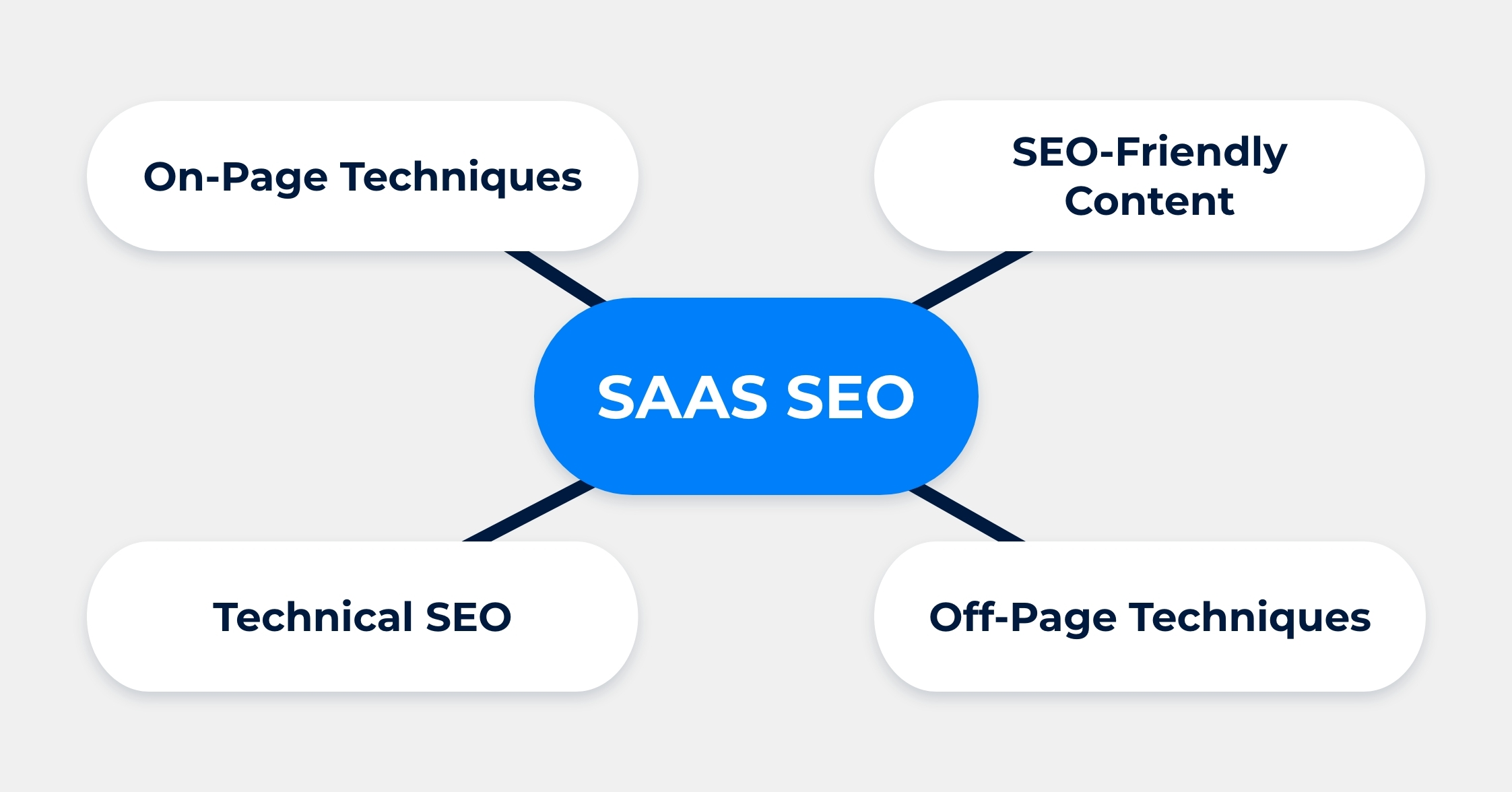
Technical SEO focuses on ensuring search engines can effectively crawl, understand, and index content.
Key priorities include:
Site Speed
Slow websites create friction.
Users leave.
Rankings suffer.
Conversions decline.
Mobile Experience
Many software buyers begin research on mobile devices, even if purchasing occurs elsewhere.
Accessibility matters.
Structured Data
Schema markup helps search engines better interpret content and product information.
Internal Linking
Strong internal linking improves discoverability and distributes authority across important pages.
Technical SEO rarely generates excitement.
It generates results.
The distinction is important.
The Role of Backlinks
Search engines interpret backlinks as signals of credibility.
When authoritative websites reference a SaaS company's content, trust increases.
At least algorithmically.
This is why link-building remains a critical component of SaaS SEO.
Common approaches include:
- Original research reports
- Industry studies
- Expert commentary
- Thought leadership content
- Digital public relations
Interestingly, the most effective link-building strategies often resemble public relations more than traditional SEO.
Companies create something worth discussing.
Others discuss it.
Links follow naturally.
Product-Led SEO
One of the most interesting developments in SaaS SEO is the emergence of product-led SEO.
Instead of publishing content about the product, companies create pages generated by the product itself.
Examples include:
- User-generated templates
- Public directories
- Marketplace listings
- Collaborative resources
These pages scale naturally.
More users create more content.
More content creates more search visibility.
More visibility attracts more users.
The cycle becomes self-reinforcing.
Several high-growth SaaS companies have used this strategy to build enormous organic footprints.
A Lesson I Learned About SaaS SEO
Years ago, I worked with a software company that measured SEO almost exclusively through rankings.
Every meeting focused on keywords.
Position changes.
Traffic growth.
The numbers looked impressive.
Yet revenue remained disappointingly flat.
The issue became obvious after examining user behavior.
Visitors arrived through broad informational content but rarely progressed further.
Traffic was abundant.
Intent was weak.
The company eventually shifted strategy.
Instead of pursuing every possible keyword, it focused on queries closely aligned with customer problems and product outcomes.
Traffic growth slowed initially.
Revenue growth accelerated.
That experience reinforced an important lesson.
SEO success is not measured by how many visitors arrive.
It is measured by how many qualified prospects discover meaningful value.
The difference is substantial.
Common SaaS SEO Mistakes
Many companies undermine performance through predictable errors.
Chasing Volume Instead of Intent
High-volume keywords appear attractive.
Yet low-intent traffic often contributes little business value.
Ignoring Bottom-of-Funnel Content
Comparison pages, alternative pages, and product-focused content frequently generate the strongest conversions.
Many organizations underinvest in them.
Publishing Without Distribution
Great content requires visibility.
Promotion remains essential.
Treating SEO as a Short-Term Initiative
SEO rewards consistency.
Results often emerge gradually.
Organizations expecting immediate returns frequently abandon efforts prematurely.
Separating SEO From Product Strategy
The strongest SaaS SEO initiatives align closely with product positioning and customer needs.
Disconnected efforts rarely perform well.
Measuring SaaS SEO Success
Traffic is useful.
It is not enough.
Meaningful SaaS SEO measurement often includes:
- Organic traffic growth
- Keyword visibility
- Lead generation
- Trial signups
- Customer acquisition
- Revenue contribution
- Customer acquisition cost reduction
The objective is business impact.
Not merely visibility.
This distinction separates mature SEO programs from superficial ones.
The Future of SaaS SEO
Search behavior continues evolving.
Artificial intelligence influences discovery.
Search engines increasingly prioritize expertise, credibility, and user satisfaction.
Yet the fundamental principles remain surprisingly stable.
People have questions.
Companies provide answers.
Trust develops.
Decisions follow.
Technology changes.
Human behavior changes more slowly.
That reality creates continuity amid constant disruption.
The Bigger Truth About SaaS SEO
SaaS SEO is often discussed as a marketing tactic.
A growth channel.
A traffic source.
Those descriptions are accurate.
Yet they miss something important.
At its best, SaaS SEO functions as a trust-building system.
Every search represents a question.
Every query reveals uncertainty.
Every visit signals curiosity.
The companies that consistently win organic search understand this dynamic.
They do not merely optimize pages.
They anticipate concerns.
They answer questions.
They reduce risk.
And perhaps that is why SaaS SEO remains so powerful.
Not because it manipulates algorithms.
Because it aligns with how people make decisions.
Customers rarely search for software simply because they want software.
They search because they want solutions.
Better workflows.
Better productivity.
Better outcomes.
The companies that understand this distinction create content differently. They focus less on rankings and more on relevance. Less on traffic and more on trust.
And in a category crowded with competing products, trust remains remarkably difficult to replicate.
Which may explain why the most effective SaaS SEO strategies often look less like search optimization and more like customer understanding.
The rankings, after all, are merely the visible result.
The real work happens long before the search.
- Arts
- Business
- Computers
- Jogos
- Health
- Início
- Kids and Teens
- Money
- News
- Personal Development
- Recreation
- Regional
- Reference
- Science
- Shopping
- Society
- Sports
- Бизнес
- Деньги
- Дом
- Досуг
- Здоровье
- Игры
- Искусство
- Источники информации
- Компьютеры
- Личное развитие
- Наука
- Новости и СМИ
- Общество
- Покупки
- Спорт
- Страны и регионы
- World

 English
 Russian
 French
 Spanish
 Portuguese
 Deutsch
 Turkish
 Dutch
Dutch
 Italiano
 Arabic
 Romaian
 Greek
Greek
