
How Do I Present Sponsorship Opportunities?
The way you present a sponsorship opportunity can determine whether a company sees it as an expense—or an opportunity worth pursuing.
That distinction is enormous.
You may have a terrific event. A loyal audience. A compelling mission. An impressive track record.
None of that guarantees sponsorship.
Because sponsors aren't simply looking for organizations that need money.
They're looking for organizations that can help them accomplish something.
More customers. Better visibility. Stronger community relationships. Valuable content. Access to a specific demographic. Employee engagement. Hospitality. Product trial.
Your job is to make that connection obvious.
Not eventually.
Immediately.
Stop Presenting Sponsorship as a Donation
One of the biggest mistakes you can make is presenting sponsorship as financial support for your organization.
“We're seeking sponsors to help make this event possible.”
That's understandable.
It's also sponsor-centered in exactly the wrong way.
A company is not automatically motivated by the fact that your event costs money to produce.
The better framing is:
“We're offering companies an opportunity to reach 5,000 local consumers through a combination of event activation, digital promotion, and direct customer engagement.”
Now we're talking about value.
Your financial need can be part of the conversation later. It should not be the entire conversation.
Think like a marketer
Before approaching a sponsor, ask:
What would this company actually want to accomplish?
A local restaurant may want foot traffic.
A bank may want relationships with business owners.
A healthcare organization may want community trust.
A technology company may want access to decision-makers.
A consumer brand may want product trial.
Your sponsorship opportunity becomes much more attractive when you present it in the language of those objectives.
Know What You're Actually Selling
A sponsorship opportunity is not a logo.
The logo is one asset.
What you're really selling might include:
- Audience access
- Brand visibility
- Customer engagement
- Content
- Hospitality
- Lead generation
- Product sampling
- Demonstrations
- Speaking opportunities
- Category exclusivity
- Community positioning
- Employee participation
- Media exposure
That distinction gives you considerably more room to create valuable packages.
Imagine an event sponsor receives only a banner.
The relationship is passive.
Now imagine that same sponsor receives a branded experience, customer sampling, a social campaign, VIP hospitality, and access to post-event content.
That's a marketing program.
Present it accordingly.
Start With the Opportunity, Not Your Organization
When you approach a potential sponsor, resist the urge to begin with your entire history.
The sponsor doesn't need your autobiography.
They need to understand the opportunity.
Open with four pieces of information:
What is it?
Who does it reach?
Why is the audience valuable?
What can the sponsor do with the opportunity?
For example:
“Our three-day regional business conference attracts more than 2,500 entrepreneurs, executives, and small-business owners, with 64% of attendees responsible for purchasing or influencing purchasing decisions within their organizations.”
That's immediately useful.
Compare it with:
“We are a nonprofit organization dedicated to empowering entrepreneurs through education and community.”
The second statement may be true.
It simply doesn't answer the sponsor's first question.
Put Audience Data Front and Center
Sponsors need to understand your audience in detail.
Don't just say how many people you reach.
Show who they are.
| Audience Information | Basic Presentation | Stronger Presentation | Sponsor Value |
|---|---|---|---|
| Attendance | 5,000 attendees | 5,000 verified attendees over three days | Scale |
| Geography | Regional | 78% from the sponsor's target market | Market fit |
| Age | Adults 25–54 | 62% ages 30–49 | Demographic fit |
| Income | Affluent audience | 47% report household income above $100K | Purchasing power |
| Professional role | Business professionals | 38% owners/founders, 29% senior managers | Decision-maker access |
| Large list | 21,400 subscribers, 39% average open rate | Direct reach | |
| Social | Strong following | 32,000 followers with monthly engagement reporting | Digital visibility |
| Activation | Booth available | Dedicated 10' × 20' space in a high-traffic area | Direct interaction |
| Measurement | Post-event recap | Attendance, leads, scans, engagement, content views | Accountability |
Use actual data.
If you don't have sophisticated analytics, use the information you do have.
Honest, relevant numbers beat inflated claims every time.
Show the Sponsor Where They Fit
This is where presentation becomes strategy.
Don't merely list benefits.
Create a picture.
Suppose you're approaching a fitness company.
You could say:
Gold Sponsor receives logo placement, social promotion, and booth space.
Or:
Gold Sponsor can create a branded wellness station where attendees receive complimentary fitness assessments, interact with coaches, scan a personalized QR code, and receive a post-event offer.
The second description is much more vivid.
It lets the sponsor imagine the activation.
That's important.
A company is far more likely to value an opportunity it can visualize.
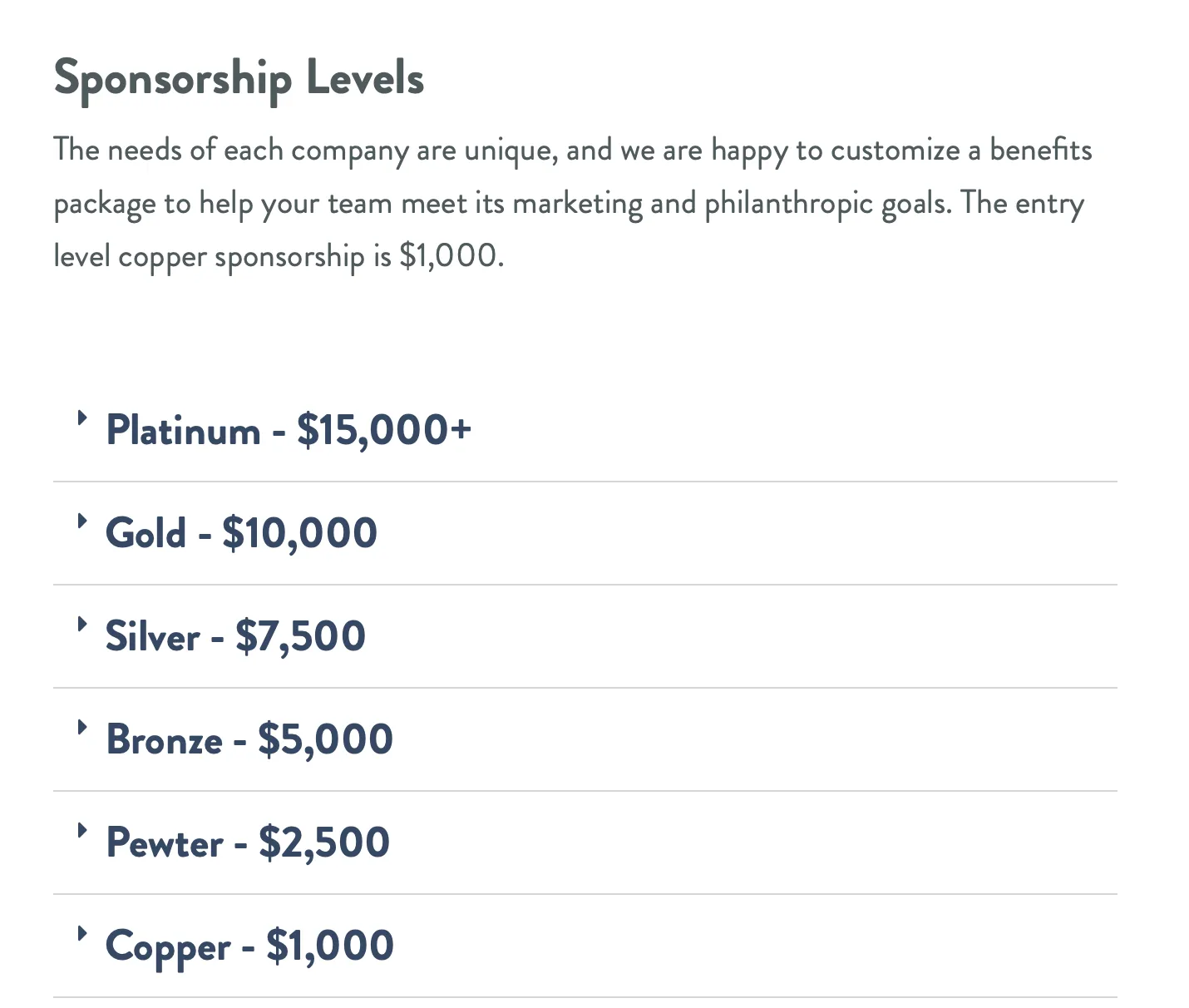
Create Clear Sponsorship Levels
Most sponsorship opportunities benefit from structure.
Three to five levels is often enough.
For example:
| Sponsorship Level | Example Investment | Visibility | Activation | Premium Benefits |
|---|---|---|---|---|
| Presenting Partner | $15,000 | Naming rights + premium placement | Signature activation | Category exclusivity, VIP hospitality |
| Gold Partner | $7,500 | High visibility | Dedicated activation area | Premium tickets, custom content |
| Silver Partner | $3,500 | Strong event recognition | Shared activation | Tickets, digital promotion |
| Community Partner | $1,000 | Basic recognition | Limited participation | Website/social acknowledgment |
| In-Kind Partner | Variable | Recognition based on contribution | Product/service integration | Customized |
These numbers are examples, not a pricing formula.
Your pricing should be based on your audience, market, benefits, exclusivity, activation potential, delivery costs, and demonstrated results.
Don't make the tiers different only by logo size
This happens constantly.
The $10,000 sponsor gets a large logo.
The $5,000 sponsor gets a medium logo.
The $2,500 sponsor gets a small logo.
That's not much of a strategy.
Higher-level sponsorships should unlock different kinds of value.
Think:
- Exclusive access
- Custom experiences
- Hospitality
- Content
- Speaking
- Product integration
- Customer interaction
- Category protection
The more strategically different the levels are, the easier it becomes for sponsors to understand why the price changes.
Sell Activation, Not Just Exposure
Exposure is easy to promise.
Activation is harder—and often much more valuable.
A strong sponsorship presentation should answer:
What can the sponsor actually do?
That might include:
Before the event
- Sponsored announcements
- Email placement
- Social content
- Promotional contests
- Co-branded content
- Media outreach
During the event
- Product demonstrations
- Sampling
- Interactive installations
- Workshops
- Speaking opportunities
- VIP hospitality
- Customer surveys
- Lead capture
After the event
- Recap content
- Sponsor photography
- Video assets
- Lead reporting
- Audience survey results
- Follow-up promotions
Suddenly, the sponsorship has a beginning, middle, and end.
That makes it feel like a campaign rather than a purchase.
Personalize the Presentation
A generic sponsorship deck says:
“Here are our packages.”
A customized presentation says:
“Here's why this opportunity makes sense for your company.”
That difference can change the conversation.
Research the prospect.
Look at its current marketing.
Understand its target customer.
Identify previous sponsorships.
Notice what the company is promoting right now.
Then connect your opportunity to that information.
For example:
“Because your company is expanding into the North County market this year, we believe our 3,200-person regional audience provides a direct introduction to consumers in that geography.”
That's considerably stronger than:
“We think you'd be a great sponsor.”
Specificity signals preparation.
Preparation builds confidence.
Tell Them What Success Looks Like
A sponsor shouldn't have to guess how you'll measure the partnership.
Give them a measurement framework.
Depending on the opportunity, you might track:
- Attendance
- Impressions
- Website traffic
- QR-code scans
- Leads
- Samples distributed
- Coupon redemptions
- Social engagement
- Email exposure
- Content views
- Customer interactions
- Media mentions
- Survey responses
But don't promise metrics simply because they sound impressive.
If you promise leads, explain how you'll collect them.
If you promise impressions, explain how you'll calculate them.
If you promise customer engagement, define what counts as engagement.
Precision makes a sponsorship opportunity feel professionally managed.
A Lesson I Learned About Presenting Opportunities
I've seen sponsorship opportunities with excellent underlying assets fail because the presentation forced the sponsor to do too much work.
The audience was strong.
The event was well established.
The organization had credibility.
But the presentation was essentially a list.
Logo here.
Banner there.
Mention in newsletter.
Tickets included.
Booth available.
The sponsor was left to figure out what all of it meant.
That was the lesson.
Don't make the sponsor assemble the value proposition themselves.
Do that work for them.
Take the assets and connect them to business objectives.
Don't say, “You get a booth.”
Say, “Your dedicated activation space gives your team an opportunity to demonstrate products and engage directly with attendees during the highest-traffic portion of the event.”
The underlying asset hasn't changed.
The perceived value has.
That's the power of presentation.
Use Proof Wherever You Can
A sponsorship opportunity becomes more credible when you can demonstrate that it has worked before.
Include:
- Previous sponsors
- Renewal rates
- Attendance history
- Audience growth
- Activation photographs
- Testimonials
- Case studies
- Media coverage
- Digital performance
- Previous sponsor results
A simple case study can outperform an entire page of adjectives.
For example:
Previous sponsor: Regional consumer brand
Investment: $7,500
Activation: Product sampling and interactive display
Results: 1,100 samples distributed, 460 customer interactions, 280 contest entries, 17,000 digital impressions
Now the prospective sponsor has something tangible to evaluate.
That's evidence.
Make the Next Step Easy
Don't finish your presentation with:
“Please let us know if you have any questions.”
That puts all the momentum on the sponsor.
Instead, propose a logical next step.
For example:
“Let's schedule a 20-minute conversation to determine which sponsorship structure best fits your marketing objectives.”
That's easier to act on.
And it changes the tone.
You're not asking for a favor.
You're opening a business discussion.
What Not to Do
Avoid these common mistakes:
Don't lead with your funding gap
Your budget problem isn't the sponsor's marketing strategy.
Don't overwhelm them with packages
Too many options create confusion.
Don't inflate your numbers
Credibility is difficult to rebuild once lost.
Don't promise guaranteed media coverage
You don't control editorial decisions.
Don't treat every sponsor identically
A customized opportunity is usually stronger than a generic one.
Don't rely entirely on logos
Visibility is only one component of sponsorship value.
Don't hide the price
Make the investment easy to find.
The Provocative Truth About Sponsorship Presentations
Here's the part many organizations don't want to hear:
Your sponsorship opportunity isn't attractive because you need it.
It's attractive when the sponsor can see what it can accomplish through it.
That means your presentation has a job beyond explaining your event.
It has to translate.
Your audience into customers.
Your venue into access.
Your platform into visibility.
Your event into an experience.
Your mission into meaningful brand alignment.
Your assets into measurable business value.
That's the real work.
And once you understand that, your sponsorship presentation becomes much more than a PDF or slide deck.
It becomes a sales tool.
A filter for good prospects.
A framework for negotiation.
And, if you've built it properly, the beginning of a relationship rather than the end of a fundraising request.
So before you send your next sponsorship presentation, don't ask:
“Does this explain everything about us?”
Ask something harder.
“Can the right sponsor see exactly why this opportunity matters to them?”
If the answer is yes, you're ready to start the conversation.
If the answer is no, keep editing.
The sponsor doesn't need more information.
They need a clearer reason to care.
- Arts
- Business
- Computers
- Giochi
- Health
- Home
- Kids and Teens
- Money
- News
- Personal Development
- Recreation
- Regional
- Reference
- Science
- Shopping
- Society
- Sports
- Бизнес
- Деньги
- Дом
- Досуг
- Здоровье
- Игры
- Искусство
- Источники информации
- Компьютеры
- Личное развитие
- Наука
- Новости и СМИ
- Общество
- Покупки
- Спорт
- Страны и регионы
- World

 English
 Russian
 French
 Spanish
 Portuguese
 Deutsch
 Turkish
 Dutch
Dutch
 Arabic
 Romaian
 Portuguese (Brazil)
 Greek
Greek